

Gutters and Roofs for Vacaville, Small Town, Big Pride
Gutter and roof installation, cleaning, repairs and rejuvenation. Family-owned since 2002, trusted by thousands of returning Bay Area homeowners.
Vacaville, in short
Where can I get sandbags in Vacaville?
The City has a sandbag station at Irene Larsen Park, on Alamo Drive near Fire Station #74. The City’s page says the station opens three to seven days before the first significant rain event and stays open throughout the season. Sand and sandbags are free; bring your own shovel.
The story of Vacaville
Vacaville, founded on land bought from Juan Manuel Vaca, “midway between Sacramento and San Francisco” in the City’s words.
The City’s account has William McDaniel buying land from Juan Manuel Vaca and agreeing that one square mile would become a township, recorded on December 13, 1851 and called Vacaville. The Vaca and Peña families had settled the valley after arriving in California in 1841, and the Peña Adobe, built in the early 1840s according to the State’s landmark text and the Peña Adobe Historical Society, still stands. Vacaville was incorporated as a city in 1892, and at one time, the City says, it was the fresh fruit capital of California.
The Peña Adobe Historical Society says the Vaca and Peña families reached southern California on November 15, 1841, after a two-month journey from the New Mexico region along the Old Spanish Trail, and met General Mariano Vallejo.
The Peña Adobe was built in the early 1840s, according to the State’s landmark text, which says 1843, and the Peña Adobe Historical Society, which says 1842. The Society calls it the oldest structure built in Solano County, and it is California Historical Landmark 534.
In 1845, the Society says, a rancho of 44,384 acres, covering all of Lagoon Valley and stretching into Yolo County, was officially granted to Vaca and Peña.
The Society says Vaca sold part of his land to William McDaniel in 1850 on the condition that a town called Vacaville be laid out; the City’s account has the one-square-mile township recorded on December 13, 1851.
William J. Pleasants established his ranch in 1856; its thirteen contributing buildings and structures, tied to the fruit growing and shipping industries, were listed on the National Register of Historic Places in 2006.
The Vaca Adobe, built east of the Peña Adobe, was destroyed by an 1892 earthquake near Vacaville, the Society says.
Vacaville was incorporated as a city in 1892.
The City says settlers first staked out ranches and then farmed the land, which gave way to major agriculture; at one time, it says, Vacaville was the fresh fruit capital of California, shipping fruit and nut products throughout the nation.
Vacaville Town Hall was erected in 1907 and originally served as the town jail, the fire department’s headquarters and the town court; the Heritage Council calls it one of the first reinforced concrete structures in the West.
The Nut Tree’s own timeline says it was born in 1921, when Helen and Ed Power set up a small fruit stand on the side of the road under a walnut tree Helen’s grandfather had planted. The City says it grew into a world-renowned restaurant complex that served travelers between the San Francisco Bay and the Sacramento Valley for almost 75 years.
The Peña Adobe stayed with the families’ descendants until 1957 and became a Vacaville City park in 1965.
The Nut Tree closed in 1996, its timeline says, and re-opened in 2006 as a mixed use development.
Fire safety
Your fire department
The Vacaville Fire Department is the City’s own fire agency, and the City’s fire code deems it the Code Compliance Agency.
What the State’s 2025 map shows
Read from the State’s 2025 fire hazard severity map, released in four phases between February 10 and March 24, 2025, a small Very High area lies inside the city, along with High and Moderate areas; most of the city is mapped as non-wildland.
State layer queried Oct 26 2026
See 5 more
Ready, Set, Go
The City’s wildfire page names Ready, Set, Go, a Cal Fire program the City adopted to help educate the community on how to plan, prepare and stay aware, and tells residents: “Be ready: create and maintain defensible space to increase your home’s chance of surviving a wildfire.”
City page, undated, read Oct 26 2026
Weed inspection on or about June 1
On or about June 1, the City’s Code Enforcement inspects properties to make sure dry vegetation, “weeds, rubbish and other fire hazards” have been removed. The City’s page says a property that stays in violation can face fines that rise over the first three days, plus costs and expenses, and that this may become a lien or special assessment upon the property.
City Code Enforcement page and the Fire Prevention Bureau’s April 1, 2025 notice; read Oct 26 2026
Tree branches, chimneys and hillside clearance
The City’s fire code, section 15.20.271.040, sets clearances. For properties of up to one acre it says tree branches within 100 feet of a structure are to be pruned to at least six feet from the ground, and branches within ten feet of the outlet of a chimney or stovepipe are to be removed or pruned for ten feet or more of clearance. For hillside residential properties it calls for not less than 100 feet of clearance around all structures and other improvements.
Section amended by Ord. 2006, dated 11/19/2025; read in Chrome Oct 26 2026
The City’s fire codes
The City’s municipal code adopts the California Fire Code and the California Wildland-Urban Interface Code, 2025 edition, each with local amendments (ordinance dated 11/19/2025).
Ord. 2006, dated 11/19/2025; code includes legislation through 08-25-2026
Zone 0, the State’s rule for the first five feet
The State’s rule for the first five feet around a home, Zone 0, is not in force yet: the Board of Forestry adopted it, it is in final review with the Office of Administrative Law, and no effective date is known.
As of the weekly check of Oct 22 2026
Need a hand with this? Gutter guards
-
From the Vacaville blog
The house that needed a hat
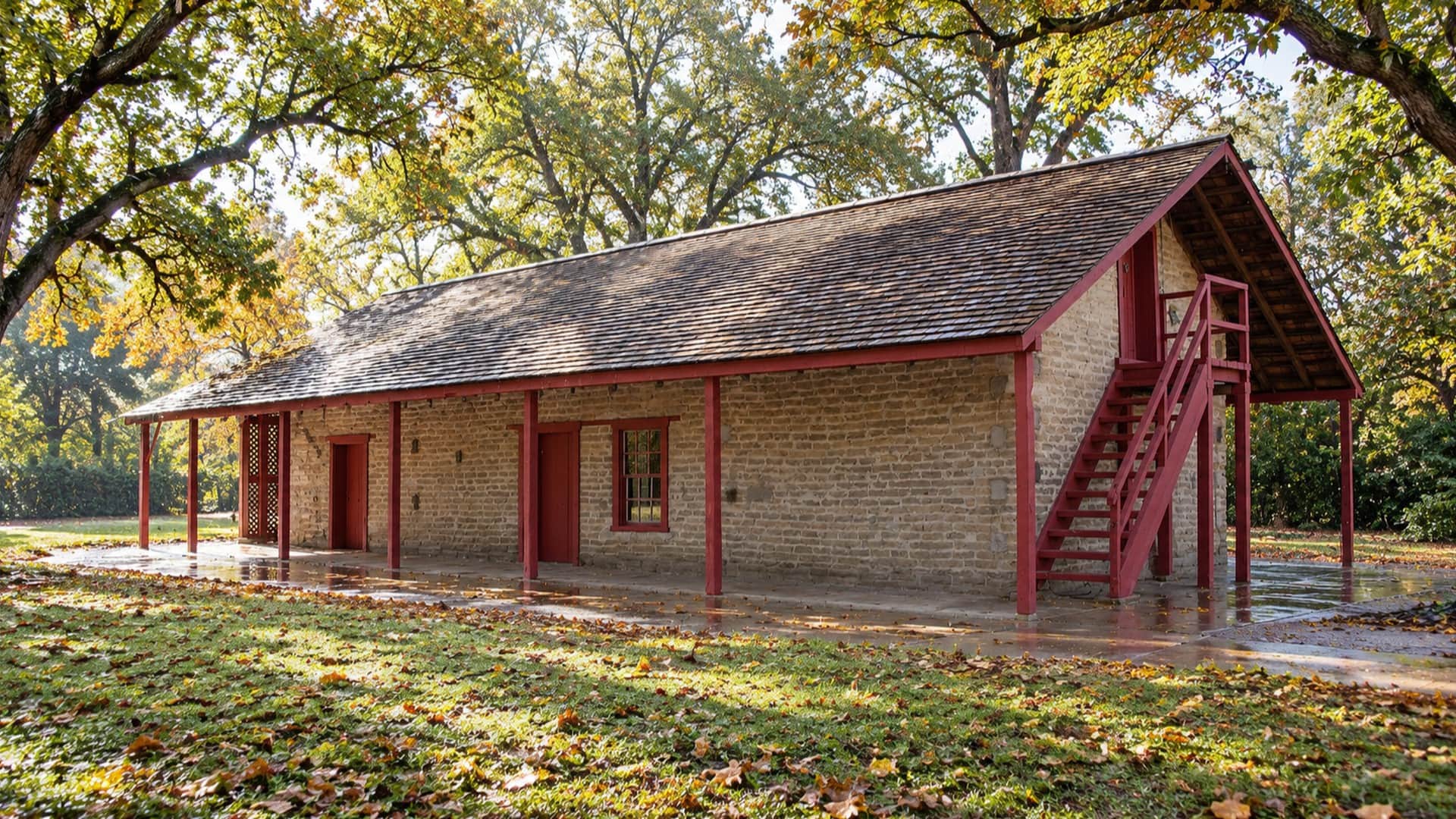
Read the whole post: The house that needed a hatThe Peña Adobe in Lagoon Valley has stood since the 1840s. Mud walls can last that long, as long as something keeps the rain off.
A Native crew sun-dried the bricks and built it for the Peña family, who had come west on the Old Spanish Trail in 1841. Its walls are two feet thick. The Peña Adobe Historical Society calls it “the oldest structure built in Solano County.”
The first roof was tule thatch. Within a few years it was replaced with hand-split redwood shakes, and by the 1880s the whole house had been wrapped in wood siding. That siding mattered more than anyone knew: the 1970 National Register form credits it for the walls’ “good condition when restored.”
The family lived there until about 1920. By the 1950s the house stood abandoned in a weedy meadow. The siding gave way, and, in the words of the walking-tour brochure the Society shares, that “exposed the adobe brick to rain, damaging the structure.” The south wall collapsed.
Volunteers put a plastic tarp over the house “to keep out the rain.” The City took title in 1961, and by 1965 the adobe was restored the old way, with sun-dried bricks and hand-split redwood. Everything but the thatch. In 2006 the roof came off again and was renewed.
It’s a lesson for any house, adobe or not: walls last as long as the roof and what’s around it keep the water off. Before the rains, check the roof, clear the gutters, and make sure the downspouts send water away from the walls. If for any reason you need a professional, give us a call, we’ll be happy to help. We have great tarps… (only kidding… 😉 Sunshine Gutters and Roofing – Let us shine on your rainy day.

Culture and history
The Peña Adobe
The City’s Peña Adobe Historic Area includes the historic adobe home and the Mowers-Goheen Museum, which hosts a free event on the first Saturday of the month, the City’s page says. The Peña Adobe Historical Society says the adobe is open the first Saturday of the month, February through December, with private tours on request. More in The story of Vacaville, below.
As the two pages print them, both undated, read Oct 26 2026
The Vacaville Museum
The Vacaville Museum, a Center for Solano County Art, History & Culture, is open Thursday and Friday from 1 pm to 4:30 pm and Saturday from 10 am to 4:30 pm; its main gallery shows “SOLE ITALIANO: Una Nuova Storia” from July 25 to November 14, 2026.
Hours and show as the museum’s home page prints them, read Oct 26 2026
See 7 more
Where the name comes from
Vacaville began as a township on land William McDaniel bought from Juan Manuel Vaca, recorded in 1851. More in The story of Vacaville, below.
Merriment on Main
The City’s downtown tree lighting is Tuesday, December 1, 2026, from 5:00 to 8:00 PM, with the fifty-foot tree lit at 6:30 PM.
December 1, 2026; the City’s event page and news release of Sept 17 2026
Día de los Muertos at Andrews Park
Each year the City holds a Día de los Muertos celebration at Andrews Park, in the CreekWalk Plaza, with music, dance, art and food; the City says the event began in 2022.
Each year; the City’s page and news release, read Oct 26 2026
Downtown farmers’ market
The Downtown Vacaville Business Improvement District lists a Saturday farmers’ market at the CreekWalk Plaza in Andrews Park, with fall hours of 9 am to 1 pm.
Hours as the district’s page prints them, read Oct 26 2026
The Nut Tree
The Nut Tree began as a roadside fruit stand in 1921, its own timeline says. More in The story of Vacaville, below.
Kids Fishing Day
The City’s save-the-date is Saturday, February 6, 2027, from 8:00 AM to 12:30 PM at Lagoon Valley Park, for the Second Annual Kids Fishing Day.
February 6, 2027; the City’s page says more information is coming soon
Vacaville Fiesta Days
The organizers’ page lists Vacaville Fiesta Days for May 27 to 30, 2027, and says they are celebrating 70 years in 2027.
May 2027; the organizers’ page, read Oct 26 2026
Community
Vacaville Heritage Council
A non-profit historical archives and research organization, established in 1968, specializing in Solano County history, with thousands of photographs and negatives, some from the 1850s. Its page says it is open to the public on Tuesdays and Thursdays from 9:00 AM to 1:00 PM and on the third Saturday of the month from 9 am to 1 pm, or by appointment for research and tours.
Hours as the page prints them, undated page, read Oct 26 2026
Neighborhood associations
The City says membership in a Vacaville Neighborhood Association is voluntary, free of charge and different from a Homeowners Association, and counts more than 18 active ones.
City rules and regulations
Re-roofs need a permit
A re-roof is permit work in Vacaville. The City’s online permit page says the City offers an express permit that can be issued instantaneously when no new additions are made to the installation, and the like-for-like replacements it lists include re-roofs; for these you apply with the permit type “Basic Residential Replacement”. Applications go in through an account on the City’s eTRAKiT portal.
City pages, undated, read Oct 26 2026
Roof repairs up to 100 square feet
The City’s building code, section 15.20.250.050, lists repairs to roof covering “not exceeding a total of 100 square feet within any 12-month period” among the work that does not need a permit.
Section amended by Ord. 2006, dated 11/19/2025; read in Chrome Oct 26 2026
See 6 more
Removing a tree of six inches or more
The City’s code requires a tree removal permit, issued by the Director of Community Development, before anyone cuts down, removes or destroys a tree of six inches or more in diameter at breast height on private property. Routine maintenance and pruning of limbs or deadwood is not covered. The City asks you to allow at least 21 days to process the permit.
Code section 14.09.250.060; the 21 days are the City page’s words; read Oct 26 2026
Trees near power lines
The City’s FAQ says removing or pruning trees near power lines “can be extremely hazardous” and refers owners to PG&E.
Whose tree is it
The City’s FAQ says “City trees are those between a sidewalk and the street” and “All other trees are the responsibility of the property owner.”
Branches over sidewalks and streets
The City’s Code Enforcement page says branches and limbs of trees and shrubs must be no lower than 7 feet over sidewalks and 14 feet over city streets.
City page, undated, read Oct 26 2026
Where roof water may go
The City’s stormwater tips for yards include “Adjust rain spouts to empty onto vegetated ground.” That is a tip on the City’s pages, not a code section.
When you buy or sell Notice of Special Tax
The City’s FAQ says homes in a Community Facilities District carry a special tax and that “When property is sold, the seller is responsible for providing a Notice of Special Tax to the buyer.”
Need a hand with this? Roofing
Storms, flood and drainage
Filling and stacking sandbags
The City says to fill bags halfway with sand, knot or fold the tops, and stack bags in a pyramid shape, offsetting them like bricks. Additional sandbag locations may open if needs arise.
City page, undated, read Oct 26 2026
Keep gutters, downspouts and drains clear
The City’s winter storm preparedness page tells residents “Clean gutters and downspouts.” and “Clear leaves from storm drains near your home.” It also says “Make sure pipes, ditches, and drainage areas on your property are clear.”
City page, undated, read Oct 26 2026
See 4 more
Check the flood map for your address
The City’s winter storm page points residents to the City’s flood map to find out whether their address is in a flood area.
City page, undated, read Oct 26 2026
Where the creeks have flooded
The City’s 2023 Safety Element says the areas susceptible to flooding include Alamo Creek at Seneca Way and Cheyenne Drive, at Tulare and Southwood Drives and at Vanden Road; Ulatis Creek at Andrews Park, Aegean Way and Leisure Town Road; Laguna Creek at Interstate 80 and Rivera Road; and Gibson Canyon Creek at Leisure Town Road.
The City’s page says adopted June 27, 2023
Rain and stream gauges
The City runs a Rain and Stream Gauge Map with eleven gauge sites; its plots update every 15 minutes, and the City warns the data “has not yet been reviewed by qualified staff”.
Landslides in the west
The City’s 2023 Safety Element says most of Vacaville is flatland, with small, scattered landslides on some sloped areas, and that western Vacaville, including the foothills of the Vaca Mountains, “has the highest risk of landslides in the community”.
The City’s page says adopted June 27, 2023
Need a hand with this? Gutter cleaning
Programs, loans and insurance
Water-saving rebates, rain barrels included
In partnership with the Solano County Water Agency, the City sponsors water conservation rebates and programs for qualifying residents. Purchases of specific water-conserving products, rain barrels among them, are eligible for rebates of up to $50, or up to $250 if all five eligible products are purchased. The page says the incentives are subject to availability and that you may be placed on a waiting list for one or more of them.
City page, read Oct 26 2026; it gives no open or closed word
Check back Treebate: a rebate for a shade tree
The City’s Treebate Program, a residential shade tree rebate pilot, offers Vacaville homeowners within the city limits a rebate of up to $50 for buying an approved tree of at least 5 gallons, one rebate per residence. Applications go in online within 90 days of purchase, with the original receipt and a photo of the tree planted in the ground. The page says the program’s length depends on available funding on a first come, first served basis, and does not say whether it is still open.
City page, read Oct 26 2026
See 10 more
County-wide Check back Rebuilding Together Solano County: free home repair for low-income homeowners
A nonprofit that provides free home repair and rehabilitation for low-income homeowners and community facilities; repairs are free to qualified and selected homeowners. Its criteria are county-wide, for owners who live in a single-family home in Solano County, and its pages name Vacaville for community-facility workdays. The application window for veteran and military homeowners ran until April 30, 2026, and no later window is posted on the pages read.
Organization’s pages, read Oct 26 2026
County-wide North Coast Energy Services: bill help and free weatherization
A provider with an office in Vacaville that helps income-qualified households pay gas, electric and propane bills and provides free weatherization and heating repair for renters and homeowners; it also offers insulation, solar screens and storm windows. Phone (707) 422-3200.
Provider’s page, read Oct 26 2026
Check back Earthquake Brace + Bolt: check back
Earthquake Brace + Bolt is an earthquake retrofit program run by the California Residential Mitigation Program, a joint body, not a State program. Its page says it “offers up to $3,000 for homeowners to seismically retrofit their houses”, that a retrofit “is only done on wood-framed, pre-1980 homes with a raised foundation”, and that registration is open for a limited time each year. Registration is not open now: the page says “The EBB Program is currently closed.” and offers a sign-up to be told when registration opens. The program’s 2025 ZIP-code list for Northern California has a row for Vacaville with ZIP codes 95687 and 95688, and says eligibility is based on ZIP code only.
Program page read Oct 20 2026 (California sheet); ZIP list read Oct 26 2026
County-wide BayREN EASE Home: weatherization for income-qualified homes
BayREN’s EASE Home page says “BayREN covers 80% of the cost for essential weatherization upgrades, including insulation and duct sealing”. To qualify you live in a single-family home (four or fewer units) built before 2010, are a PG&E customer, and have a household income under or at 120% of area median income. Its eligibility tool asks “What County do you live in?” and lists Solano among nine counties; the page names no city or ZIP, and does not mention roofs, gutters or drainage.
Program page read Oct 25 2026
Check back PG&E Energy Savings Assistance: check back
PG&E’s page says the program lets you “Improve the energy efficiency of your home at no cost to you”, for those who live in a house, mobile home or apartment at least five years old, and that its income guidelines are “Valid through May 31, 2027”. PG&E’s service-area page lists Vacaville in its Solano County electric and gas lists.
Page read Oct 25 2026; income guidelines valid through May 31, 2027
State-wide Check back California Safe Homes: check back
California Safe Homes, the State’s home-hardening grant program run through the Department of Insurance, is not open: no dated State page says it is, and the Department’s 2026 press-release index lists no Safe Homes item.
Press-release index read Oct 20 2026
State-wide LIHEAP and the Weatherization Assistance Program
LIHEAP, the federal home energy assistance program, and the Weatherization Assistance Program run through local providers. The State’s Department of Community Services and Development says “Use the Find Services in Your Area function to locate the agency in your area, then contact them to apply for assistance.” Its listing for Solano County names an energy bill assistance and weatherization provider, the one in the North Coast Energy Services item on this card. The pages give no open or closed word and no deadline.
State pages read Oct 20 2026; the Solano County listing as the county sheet read it, Oct 25 2026
Insurance Flood insurance and the City’s rating
The City’s hazard-plan annex says Vacaville has taken part in the National Flood Insurance Program since 1982 and is in good standing, and that the City “joined the program in 1995 and maintains a rating of 8”; its table gives Community Rating System class 8. FEMA’s Community Status Book, dated 10/26/2026, also lists class 8 for the City, by our reading of its columns.
Annex adopted by Resolution 2022-050; FEMA list dated 10/26/2026
Insurance Homeowners policies and flood damage
The City’s winter storm page says “Standard homeowners insurance policies typically do not cover flood damage.” and that “Flood insurance through the National Flood Insurance Program generally takes 30 days to go into effect, so plan ahead.”
City page, undated, read Oct 26 2026
Insurance State fire-risk listing
The Board of Forestry’s Fire Risk Reduction Community List 2026, effective July 1, 2026, names the City of Vacaville and the Vacaville Fire Protection District. The Department of Insurance’s Safer from Wildfires page says that “Fire Risk Reduction Communities are local agencies located in a state responsibility area or a very high fire hazard severity zone that meet best practices for local fire planning” and that they “are certified by the California Board of Forestry and Fire Protection”.
Board list effective July 1, 2026; Department’s page read Oct 26 2026
Who serves your home in Vacaville
- Fire: The City’s Vacaville Fire Department. A separate agency, the Vacaville Fire Protection District, governed by the Solano County Board of Supervisors, has its office in town; its own pages do not state its service area.
- Water: The City of Vacaville provides drinking water to households and businesses within City limits.
- Sewer: The City provides sewer collection and treatment within city limits and to the town of Elmira.
- Garbage: Recology Vacaville Solano, which serves the City and the surrounding county; its published rates apply to customers inside the city limits.
- Electricity: PG&E: its service-area page lists Vacaville in its Electric Service Territory list for Solano County.
- Gas: PG&E: its Gas Service Territory list for Solano County includes Vacaville.
- Schools: Vacaville Unified School District, which offers an address look-up for school boundaries, and Travis Unified School District, which says it serves “portions of the cities of Vacaville and Fairfield”, with two of its elementary schools in the south of Vacaville.
- Air: The Yolo-Solano Air Quality Management District: its wood-smoke program page says its district includes all of Yolo County and the northeastern portion of Solano County, including Dixon, Rio Vista and Vacaville.
- Storm drains and creeks: The City’s Public Works Maintenance Division: before each rainy season its crews flush culverts and address known problem areas, and its Creek Maintenance Team regularly cleans City-owned V-ditches.
- Property tax information: The Solano County Tax Assessor’s website: the City’s FAQ says it holds current, comprehensive tax information, found by typing the home’s address into the search bar.
- Flood control: The Solano County Water Agency, whose page says “SCWA also has authority to deal with all flood control matters within the boundaries of SCWA” and that its boundaries “include the entire County of Solano”; it is responsible for operating and maintaining the Ulatis Flood Control Project and the Green Valley Flood Control Project.
- County alerts: Alert Solano, the county’s regional emergency notification system; the Solano County Water Agency’s flood page asks residents to sign up for it.
Useful links: Vacaville Unified School District · Travis Unified School District · Vacaville Fire Department · Vacaville Fire Protection District · City of Vacaville: Rain and Stream Gauge Map · Alert Solano (county alerts) · Recology Vacaville Solano · Vacaville Museum · Peña Adobe Historical Society · Vacaville Heritage Council
The homes of Vacaville
Vacaville’s median home was built in 1985. About 39 percent of its homes were built before 1980, about 72 percent are detached single-family houses and about two in three are owner-occupied, our own calculations from the Census Bureau’s 2020-2024 tables.
1856 onward
A fruit ranch
The Pleasants Ranch farm complex has an 1890s farmhouse, and its other buildings date to the late 19th and early 20th centuries, tied to fruit growing and shipping.
1892
Queen Anne
The National Park Service gives the Will H. Buck House, on Buck Avenue, a Queen Anne style and a significant year of 1892.
1940s-1980s
Small single-story homes
The City’s draft Housing Element of October 2022 reports that its April 2022 survey found small single-story homes with detached garages or carports in most surveyed neighborhoods, with the stock ranging in age from the 1940s to the 1960s-1980s.
Older roofs and gutters need a different hand: Gutter Repair · Roof Repair · Gutter Installation
The story of Vacaville
History and character
The Peña Adobe Historical Society says the Vaca and Peña families reached southern California on November 15, 1841, after a two-month journey from the New Mexico region along the Old Spanish Trail, and met General Mariano Vallejo.
The Peña Adobe was built in the early 1840s, according to the State’s landmark text, which says 1843, and the Peña Adobe Historical Society, which says 1842. The Society calls it the oldest structure built in Solano County, and it is California Historical Landmark 534.
In 1845, the Society says, a rancho of 44,384 acres, covering all of Lagoon Valley and stretching into Yolo County, was officially granted to Vaca and Peña.
The Society says Vaca sold part of his land to William McDaniel in 1850 on the condition that a town called Vacaville be laid out; the City’s account has the one-square-mile township recorded on December 13, 1851.
William J. Pleasants established his ranch in 1856; its thirteen contributing buildings and structures, tied to the fruit growing and shipping industries, were listed on the National Register of Historic Places in 2006.
The Vaca Adobe, built east of the Peña Adobe, was destroyed by an 1892 earthquake near Vacaville, the Society says.
Vacaville was incorporated as a city in 1892.
The City says settlers first staked out ranches and then farmed the land, which gave way to major agriculture; at one time, it says, Vacaville was the fresh fruit capital of California, shipping fruit and nut products throughout the nation.
Vacaville Town Hall was erected in 1907 and originally served as the town jail, the fire department’s headquarters and the town court; the Heritage Council calls it one of the first reinforced concrete structures in the West.
The Nut Tree’s own timeline says it was born in 1921, when Helen and Ed Power set up a small fruit stand on the side of the road under a walnut tree Helen’s grandfather had planted. The City says it grew into a world-renowned restaurant complex that served travelers between the San Francisco Bay and the Sacramento Valley for almost 75 years.
The Peña Adobe stayed with the families’ descendants until 1957 and became a Vacaville City park in 1965.
The Nut Tree closed in 1996, its timeline says, and re-opened in 2006 as a mixed use development.
Vacaville, roof and gutters
Vacaville sits where the Sacramento Valley meets the Coast Ranges, the City’s General Plan says. The Vaca Mountains, Alamo Creek Ridge and the English Hills run along its western borders, and the major creeks inside the city are Alamo Creek, Ulatis Creek, Horse Creek and Gibson Canyon Creek.
Yearly rain averages about 25 inches at the two nearest federal weather stations, Vacaville Nut Tree Airport (24.84 inches) and the Vacaville cooperative station (25.60 inches; it closed in 2009, and its 1991-2020 normal is still published). At both, about 91 percent of the rain falls from November to April, by our own calculation, and July is the driest month.
The City’s 2023 Safety Element says Vacaville has historically been at risk of flooding mainly in the winter and spring, when streams swell with heavy rainfall, and lists major floods in or around the city in 1986, 1996-1997, 2002 and 2005-2006. To hold flood water the City has 21 detention basins, mostly along the major creeks, and ten more are proposed.
Creeks in Vacaville generally flow east-southeast and drain to the Sacramento River by way of Cache Slough. The southern part of the city drains either to the Noonan Drain, which discharges to Barker Slough, or to Union Creek, which discharges to Suisun Bay.
In Centennial Park the City and the Solano Resource Conservation District planted over 575 riparian trees along two tributaries of Horse Creek. The City’s panel names eleven native species, including valley oak, interior live oak, California sycamore, cottonwood and three willows, and says the more drought-tolerant ones make great additions to home landscaping. The Forest Service says box elder leaves drop throughout the fall and winter and its winged fruit is dispersed from September through March.
We have been working on Bay Area roofs and gutters since 2002. If yours hasn’t had a look in a while, we’d be glad to come by.
Landmarks and parks
Peña Adobe
The adobe home and the Mowers-Goheen Museum; the Willis Linn Jepson Memorial Garden is also in the park.
Old Town Hall
Now the Heritage Council’s office, with the Solano County Genealogical Society upstairs; on the National Register of Historic Places (1978 on the National Park Service record, 1984 in the Heritage Council’s history).
Vacaville Museum
A Center for Solano County Art, History & Culture on Buck Avenue.
Lagoon Valley Park
A 306-acre City park around Lagoon Lake, a 100-acre lake open to non-motorized boating, with groves, multi-use trails into adjoining open space, a 27-hole disc golf course and a dog park.
Centennial Park
A City community park of about 276 acres on Browns Valley Road, with ball fields, trails, tennis and pickleball courts and soccer fields; a bike park is the first phase of its master plan.
Andrews Park and CreekWalk Plaza
The City holds its downtown events at the CreekWalk Plaza in Andrews Park, and the Heritage Council puts the first town jail on the banks of Ulatis Creek in what is today Andrews Park.
Glen Eagle Open Space and Caligiuri Park and Preserve
Both are reached from a trailhead on Vaca Valley Parkway across from Wrentham Drive.
How we can help in Vacaville
Why Sunshine Gutters and Roofing
- Family-owned since 2002, trusted by thousands of returning Bay Area homeowners
- Licensed (CSLB #1053780), bonded, with $2 million in general liability coverage
- Our own crew, never subcontractors
- We keep track of local regulations, fire safety rules and insurance programs
- We show you what we found, with photos, so you decide what happens next
The year in Vacaville
| January | Wettest month at the Nut Tree Airport weather station |
|---|---|
| February | Kids Fishing Day at Lagoon Valley Park (February 6, 2027) |
| May | Vacaville Fiesta Days (May 27-30, 2027) |
| July | Driest month at both nearby weather stations |
| December | Wettest month at the cooperative weather station Merriment on Main, the downtown tree lighting (December 1, 2026) |
Vacaville questions
What Vacaville homeowners ask us
Do I need a permit to replace my roof in Vacaville?
To replace it, yes. The City’s online permit page says the City offers an express permit that can be issued instantaneously when no new additions are made to the installation, and its list of like-for-like replacements includes re-roofs, under the permit type “Basic Residential Replacement”. If you wish, we can also pull the permit for you, as most of our customers ask us to. The City’s building code lists repairs to roof covering “not exceeding a total of 100 square feet within any 12-month period” among the work that does not need a permit.
Do I need a permit to take down a tree on my property in Vacaville?
Yes, if the tree is six inches or more in diameter at breast height. The City’s code requires a tree removal permit, issued by the Director of Community Development, before anyone cuts down, removes or destroys such a tree on private property. Routine maintenance and pruning of limbs or deadwood is not covered, and neither are commercial fruit trees, almond trees or grafted English walnut trees. The City asks you to allow at least 21 days to process the permit.
Should I clean my gutters before the rains in Vacaville?
The City’s winter storm preparedness page lists it among the steps for residents: “Clean gutters and downspouts.” and “Clear leaves from storm drains near your home.” It adds that “Property owners are responsible for protecting their property from flooding.”
Where may I send my downspouts in Vacaville?
The City’s stormwater tips for yards say “Adjust rain spouts to empty onto vegetated ground.” That is a tip on the City’s pages, not a code section. For the rainy season the City also asks residents to “Make sure pipes, ditches, and drainage areas on your property are clear.”
What our customers say









Get a free estimate
We usually respond promptly within the day. Phone first for emergencies: (510) 525-0880.
Where we work
Vacaville neighbourhoods we serve


Downtown
The City’s Land Use Element says the Downtown area, especially the Historic District, is a unique area within the city, and the City runs a Downtown Specific Plan.
Browns Valley
The Browns Valley Neighborhood Association is registered with the City, and Browns Valley Road leads to Centennial Park.
Nut Tree
The City’s history page calls the Nut Tree restaurant a true icon along I-80, and the City has policy plans for Nut Tree Ranch and Nut Tree Business Park.
Lagoon Valley
The Lower Lagoon Valley area is in the southwest corner of the city, according to the Land Use Element; a registered neighborhood association carries the name.
Foxboro
A City policy-plan area, the Gonsalves-Lockie (Foxboro) Policy Plan; two registered associations carry the name, Foxboro Friends and Foxboro South.
North Village
A specific plan area in the northeast sector of the city; two registered associations carry the name, Avondale at North Village and Haven North Village.
Roberts Ranch
One of the specific plans on the City’s list of adopted plans; the Roberts’ Ranch Neighborhood Association is registered with the City.
Brighton Landing
A specific plan area on the City’s list of adopted plans; a registered neighborhood association carries the name.
Southtown
Southtown and Southtown Commons are contiguous developments in the South Vanden area, the Land Use Element says; SouthTown Collaborative is a registered association.
Markham
The Markham Neighborhood Association is registered with the City, and Edwin Markham Elementary is among the Vacaville Unified schools.
Fairmont
Fairmont Neighbors is a registered association, and Fairmont Elementary is a Vacaville Unified school.
Alamo Drive corridor
Three City policy plans cover it: East Side of Alamo Drive, Interstate 80/Alamo Drive and Peabody-Alamo Office Center.
Also serving nearby: Fairfield · Hartley · Elmira