

Gutters and Roofs for Richmond, the City of Pride and Purpose
Gutter and roof installation, cleaning, repairs and rejuvenation. Family-owned since 2002, trusted by thousands of returning Bay Area homeowners.
Richmond, in short
Does Richmond ask owners to clear leaves and needles from roofs and gutters?
Yes, in the very high fire hazard zones on the map the City adopted on June 3, 2025. Its 2026 wildfire brochure tells owners to remove dead or dry leaves and needles from roofs and gutters, and to keep 100 feet of defensible space, by a yearly deadline in June, when the City’s inspections start.
The story of Richmond
The home front city on the bay: “The City of Pride and Purpose”.
The Santa Fe railroad set its western terminus at Point Richmond in 1899, the Standard Oil refinery followed in 1901, and Richmond incorporated in 1905. In January 1941 the Kaiser shipyards “sprang up on Richmond’s South Shoreline,” and 747 ships were built here in the war. Today the Rosie the Riveter/WWII Home Front National Historical Park tells that story from the Richmond waterfront.
In the City’s account, the Ohlone “settled here an estimated 5,000 years ago” and “built extensive shell mounds along the Bay.”
From the 1910s, more than a dozen nurseries owned by Japanese American families flourished in Richmond.
In 1823 Don Francisco Castro was granted the land that became Rancho San Pablo, and Point Richmond was its “Potrero (pastureland).”
Augustin Macdonald’s idea brought the Santa Fe’s western terminus to Point Richmond in 1899; the first overland train from Chicago arrived in 1900, and the Santa Fe shops and Standard Oil’s refinery came in 1901. Richmond incorporated in 1905 and became a charter city in 1909.
“Within a few years,” the City says, Winehaven, the Pullman shops, American Radiator, Standard Sanitary and Stauffer Chemical arrived; downtown “emerged as the City’s business and retail center” in the 1920s and 1930s.
The Kaiser Richmond Shipyards, “one of the biggest wartime shipbuilding operations on the West Coast” in the City’s words, sprang up in January 1941; the yards built about 20 percent (519) of the country’s Liberty ships.
In the City’s words, the town grew from “23,600 in 1940 to over 93,700 in 1943”.
The National Park Service says Kaiser’s yards “were among the first to employ women and people of color in significant numbers”; in the City’s 2009 account, women were over a quarter of the shipyard workforce by 1944.
The shipyards closed in 1945; the City names four later changes that “transformed Richmond’s geography”: Marina Bay, Hilltop Shopping Center, the Knox Freeway and the Richmond Parkway.
Betty Reid Soskin worked as a file clerk in a Boilermakers’ union hall during the war, and by 2007 she was a permanent Park Service ranger at the Rosie the Riveter park, sharing her own memories with visitors. She died on December 21, 2025.
In the City’s 2012 account, the Rosie the Riveter Memorial was dedicated at Marina Bay Park in 2000, the year the national historical park was established; the SS Red Oak Victory is now a floating museum.
Italian, Mexican American and Laguna and Acoma pueblo families built communities here (the City’s 2009 account), and the Richmond Art Center has been “Sharing art and creating with the community since 1936.”
Fire safety
The 2026 wildfire brochure
What the City asks owners in its very high fire hazard zones: clearing leaves and needles from roofs and gutters, defensible space and the yearly dates.
Updated Oct 7, 2026
Keep gutters clear, the City says
The brochure lists removing dead or dry leaves and needles from roofs and gutters among its requirements.
2026 edition
See 2 more
The City inspects the high-risk zones yearly
The Fire Department lists annual wildland-urban interface inspections among its wildfire measures.
Fix a fire-rule notice within 30 days
“Violation notices must be corrected within 30 days.”
Need a hand with this? Gutter guards
-
From the Richmond blog
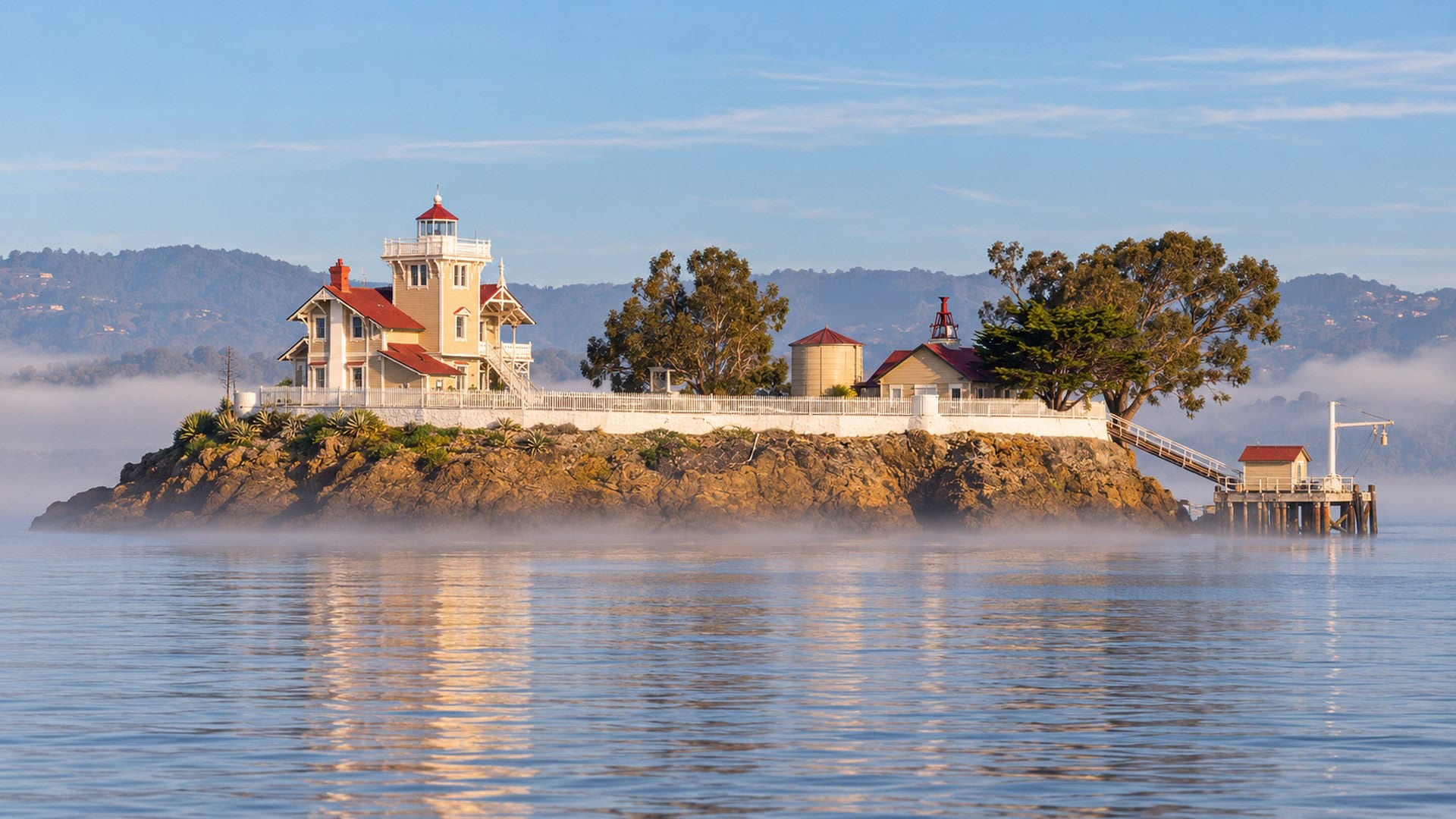
The island that waits for rain
Read the whole post: The island that waits for rainOn East Brother, rain isn’t just weather. It’s the water supply.
When the lamp was first lit on March 1, 1874, the fog whistle stayed quiet. It ran on steam, and “there had not been enough rain to provide water for the boiler.” The district engineer had a choice: wait for the next rainy season, or buy fresh water and ship it out. Then the fog drifted in, and that settled it. On May 1 the whistle went into regular use whenever there was fog.
The island was built around catching rain. A concrete slab covers most of it, a catch basin that drains into a cistern, and it needed looking after. Jack Lewis, who wrote down memories of the station in 1973, remembered gulls all summer, and then: “Come the rainy season the watershed would have to be thoroughly scrubbed and the cistern cleaned. As long as I was around that was my job.” The keeper, Willard Miller, would lower Lewis down in a bosun’s chair to clean out the debris. The cistern even had a tenant: an albino frog, “snow white and had no eyes,” who lived there at least five years.
When the station was automated, the plan was to tear the old buildings down and put a light on a pole. A group of Richmond residents vowed to save it. Today a nonprofit runs it as an inn, and it still lives on rain. Stay one night and you can’t shower: “We rely on a rainwater catchment and cistern to meet all of our water needs.”
Most of us get our water from a tap, but every roof still catches rain. Before the rainy season, the leaves and debris come off it and out of the gutters, so the water goes where it should. No bosun’s chair required. If ladders aren’t your thing, that part’s ours.

Culture and history
The home front city on the bay
In January 1941 the Kaiser shipyards sprang up on the South Shoreline; 747 ships were built here in the war.
The Plunge turns 100
Built in 1926 as the Municipal Natatorium, “turning 100 years in 2026.”
See 3 more
Children’s art show at the Museum
“Juntos Creamos / Together We Create”, the third annual showcase, October 17 to November 15.
October
Shimada sister city turns 65
The Council voted for the Shimada affiliation on October 16, 1961.
Holiday Arts Festival
The Richmond Art Center’s 64th annual festival, with 50 local artists and makers and more.
December
Community
Find your neighbourhood council
The City’s map shows which neighborhood and Council district you live in.
West Contra Costa Fire Safe Council
A nonprofit offering wildfire preparedness education to West County residents.
See 3 more
Point Richmond History Association
Founded in 1979; its little museum was saved and moved in 1990.
Richmond Museum Association
Founded 1954 to preserve local history; it owns the Red Oak Victory, run by volunteers.
Richmond-Shimada Friendship Commission
The City commission that runs exchanges with Shimada, Japan.
City rules and regulations
How to get a building permit
Who may pull a permit, how to apply through the City’s portal, and when the counter is open.
Updated Oct 7, 2026
Re-roofing needs a photo first
“Re-roofing requires a photo of the existing roof for Planning Department approval.”
See 5 more
Street trees need a City permit
A permit from the Recreation and Parks Director is needed to cut, trim or remove a tree in a public place.
Ground drainage and the street
A Public Works permit is needed to divert drainage to a public road or to fill a storm-water ditch.
Work without a permit costs triple
The City’s investigation fee for unpermitted work is 3 times the permit fee.
When you buy or sell A sewer lateral certificate
All three sewer agencies require a lateral certificate at sale; which rule applies depends on the address.
When you buy or sell No roof drains into the sewer
West County Wastewater passes a lateral only with no roof or yard drainage connected to it (its area only).
Need a hand with this? Roofing
Storms, flood and drainage
A free City visit for a flooding problem
Public Works will visit a property to review its flood problem and explain ways to stop flooding or prevent damage.
Updated Oct 7, 2026
Most rain falls November to March
About 83 percent of the year’s rain; December is the wettest month.
See 4 more
Check your flood zone
The City’s Flood Protection page links FEMA’s Flood Zone Lookup.
City help for blocked streams
The stream maintenance program can help remove major blockages, such as downed trees.
Storm drains run to the Bay
The City’s storm drains are not connected to the sewer; what enters them ends up in the Bay.
The County’s 7-5-3-2 flood rule
Watch for 7 inches in the season, 5 in 30 days, 3 in 7 days and 2 in 24 hours.
Need a hand with this? Gutter cleaning
Programs, loans and insurance
Habitat home repairs, roofs included
Habitat for Humanity East Bay/Silicon Valley lists Richmond and names roof repairs among its critical repairs.
Free review of your assessed value
The County Assessor offers a free informal value review.
See 3 more
Energy programs the City points to
BayREN, PG&E, MCE and state weatherization programs, which the City does not administer.
Insurance Flood is not covered by home policies
“Homeowner’s insurance policies do not cover damage from floods”; flood insurance has a 30-day wait.
Insurance Zone maps don’t set rates
The City says fire hazard maps “do not determine insurance rates.”
Who serves your home in Richmond
- Fire: Richmond Fire Department
- Water: EBMUD, the whole city
- Sewer: By address: the City’s system, West County Wastewater, or Stege Sanitary District
- Garbage: Republic Services, under the City’s franchise
- Electricity: MCE, delivered by PG&E
- Gas: PG&E
- Air: Bay Area Air District
- Flood control: Contra Costa County Flood Control District
- Assessor: Contra Costa County Assessor
Useful links: West Contra Costa Unified School District · East Bay Regional Park District · Contra Costa Community Warning System (county alerts) · FEMA Flood Zone Lookup (from the City’s page) · AC Transit · WestCAT · BART · San Francisco Bay Ferry · 211 Contra Costa
The homes of Richmond
Richmond’s homes are older than the county’s: the median home was built in 1966, against 1978 for Contra Costa. About a third went up between 1940 and 1959, and about two in three in 1979 or earlier.
Before about 1915
Victorians and early cottages
Queen Anne, Craftsman, Shingle and vernacular cottages, mostly one storey, in Point Richmond, Santa Fe and Coronado.
“the most popular roof forms were gable, hip or a combination” (the City’s 2009 account).
About 1910-1925
Craftsman years
Craftsman, the most pervasive style, with some two-storey American Foursquares; most were later re-clad in stucco, asbestos shingle or aluminum.
1920s-1930s
Spanish Eclectic and Tudor
Spanish Eclectic in stucco with clay tile accents and flat roofs; Tudor Revival with “steep, asymmetrical roofs.”
1940-1945
Wartime Defense Homes
Small one-storey cottages “with either hip or gable roofs”, in Atchison Village and Nystrom Village.
1949-1958
Post-war Ranch and Minimal Traditional
Small one-storey homes in stucco or plywood that “often have low-pitched hip roofs”; Parchester Village was built in 1949.
1970s on
Waterfront and hill developments
Marina Bay, built from the mid-1970s on the old shipyard basin, and Brickyard Cove, developed in the early 1970s.
Older roofs and gutters need a different hand: Gutter Repair · Roof Repair · Gutter Installation
The story of Richmond
History and character
In the City’s account, the Ohlone “settled here an estimated 5,000 years ago” and “built extensive shell mounds along the Bay.”
From the 1910s, more than a dozen nurseries owned by Japanese American families flourished in Richmond.
In 1823 Don Francisco Castro was granted the land that became Rancho San Pablo, and Point Richmond was its “Potrero (pastureland).”
Augustin Macdonald’s idea brought the Santa Fe’s western terminus to Point Richmond in 1899; the first overland train from Chicago arrived in 1900, and the Santa Fe shops and Standard Oil’s refinery came in 1901. Richmond incorporated in 1905 and became a charter city in 1909.
“Within a few years,” the City says, Winehaven, the Pullman shops, American Radiator, Standard Sanitary and Stauffer Chemical arrived; downtown “emerged as the City’s business and retail center” in the 1920s and 1930s.
The Kaiser Richmond Shipyards, “one of the biggest wartime shipbuilding operations on the West Coast” in the City’s words, sprang up in January 1941; the yards built about 20 percent (519) of the country’s Liberty ships.
In the City’s words, the town grew from “23,600 in 1940 to over 93,700 in 1943”.
The National Park Service says Kaiser’s yards “were among the first to employ women and people of color in significant numbers”; in the City’s 2009 account, women were over a quarter of the shipyard workforce by 1944.
The shipyards closed in 1945; the City names four later changes that “transformed Richmond’s geography”: Marina Bay, Hilltop Shopping Center, the Knox Freeway and the Richmond Parkway.
Betty Reid Soskin worked as a file clerk in a Boilermakers’ union hall during the war, and by 2007 she was a permanent Park Service ranger at the Rosie the Riveter park, sharing her own memories with visitors. She died on December 21, 2025.
In the City’s 2012 account, the Rosie the Riveter Memorial was dedicated at Marina Bay Park in 2000, the year the national historical park was established; the SS Red Oak Victory is now a floating museum.
Italian, Mexican American and Laguna and Acoma pueblo families built communities here (the City’s 2009 account), and the Richmond Art Center has been “Sharing art and creating with the community since 1936.”
Richmond, roof and gutters
Richmond is a bay-side city with hills behind it. The shoreline runs along its north, west and south edges. The ground rises from the shore toward the ridges on the east side, where the City’s own plan puts the high watershed at over 700 feet, with slopes of 10 to 20 percent along the eastern ridgeline. Most of the city is nearly flat, sloping about 1 percent from east to west.
The rain comes in the cold months. Yearly rain averages about 25 inches at the two nearest federal weather stations, and about 83 percent of it falls from November to March at the nearest one. Whatever is sitting in the gutters when the first storm of the season arrives is what the storm finds.
Most homes here are older. The median home was built in 1966, and about two in three were built in 1979 or earlier. About six in ten are single-family houses that stand apart. Point Richmond is the oldest part of town, with Victorian homes from 1910 or earlier in a National Register historic district. Atchison Village was built as defense housing in 1941, around a park, on winding streets. The Kaiser shipyards on the South Shoreline opened in January 1941, and the City still calls the years after explosive growth.
On the east side, the hill parkland at Wildcat Canyon and Alvarado Park is in a very high fire hazard severity zone on the map the City adopted on June 3, 2025: most of it in the City’s own zone, with a strip along the eastern city line in the State’s.
We have been working on Bay Area roofs and gutters since 2002. If yours has not had a look in a while, we would be glad to come by.
Landmarks and parks
Rosie the Riveter Visitor Center
The national historical park’s center, on the Richmond waterfront.
SS Red Oak Victory
Launched November 9, 1944, the last ship left from the Kaiser yards.
Rosie the Riveter Memorial
A walkway the length of a ship’s keel at Marina Bay Park.
Point Richmond Historic District
Victorian structures from 1910 and earlier.
East Brother Light Station
A wood frame lighthouse begun in 1873.
The Richmond Plunge
The 1926 Municipal Natatorium, turning 100 in 2026.
Alvarado Park
Depression-era stonework and a stone arch bridge over Wildcat Creek.
Miller/Knox Regional Shoreline
A lagoon, picnic areas and views of the Bay.
How we can help in Richmond
Why Sunshine Gutters and Roofing
- Family-owned since 2002, trusted by thousands of returning Bay Area homeowners
- Licensed (CSLB #1053780), bonded, with $2 million in general liability coverage
- Our own crew, never subcontractors
- We keep track of local regulations, fire safety rules and insurance programs
- We show you what we found, with photos, so you decide what happens next
Our work in and near Richmond

New seamless gutters
The year in Richmond
| January | Assessment lien date Jan 1 |
|---|---|
| June | Defensible-space deadline; inspections begin |
| July | Rain season count starts Jul 1; tax appeals open Jul 2 |
| November | Rainy season begins Tax appeals close Nov 30 |
| December | Wettest month |
Richmond questions
What Richmond homeowners ask us
Do I need gutter guards on my Richmond home?
The City’s 2026 wildfire brochure says: “Use gutter guards and keep free of leaves and needles at all times.” Its 2020 wildfire plan adds that gutter covers, if installed, need to be noncombustible, and it warns that covers can let debris pile up behind the gutter, so some cleaning may still be needed.
Do I need a permit to re-roof my house in Richmond?
To re-roof, yes. Richmond’s building permit page lists re-roofing among the permits it issues on receipt, once a photo of the existing roof is approved by the Planning Department. If you wish, we can also pull the permit for you, as most of our customers ask us to. Repairs usually don’t need one.
Does a roof in Richmond’s fire zone have to be Class B?
In the very high zones, the City’s own section of its fire code requires a Class B roof on new buildings, and at least a Class B covering when half or more of a roof is replaced within a year. The same ordinance (April 7, 2026) also adopts the State’s wildland code, and the State’s building code has its own roof-class rule that we have not read here; for the class that applies at your address, ask the City’s building department. We install Class A roofs.
Do I need a permit to trim or remove a tree in Richmond?
On a street, in a park or in another public place, yes. The code says no one may cut, trim, prune or remove a tree there without a permit from the Superintendent, the City’s Recreation and Parks Director. For a tree on your own lot that overhangs a public way, the code says you must keep it from becoming a hazard to travel or sight.
What our customers say









Get a free estimate
We usually respond promptly within the day. Phone first for emergencies: (510) 525-0880.
Where we work
Richmond neighbourhoods we serve


Point Richmond
“One of the first communities built in the City,” with Victorians from 1910 and earlier.
Marina Bay
Built from the mid-1970s on the old Inner Harbor Basin, the site of the wartime shipyards.
Downtown and Civic Center
Emerged as the City’s business and retail center in the 1920s and 1930s.
Iron Triangle
Hilltop
Hilltop Mall opened in 1976.
Atchison Village
Built in 1941 as defense housing for shipyard families, now managed cooperatively.
Parchester Village
Built in 1949, “advertised as an integrated neighborhood ‘for all Americans.'”
Santa Fe
One of the City’s central neighbourhoods, where early homes had gable or hip roofs.
Pullman
The Pullman Company refurbished sleeping cars at its Carlson Avenue plant until 1959.
Greenridge Heights
San Pablo Avenue corridor
23rd Street corridor
“Dine and shop on 23rd Street.”
Cutting Boulevard corridor
Home to the wartime Kaiser Permanente Field Hospital and the original Fire Station 67.
Also serving nearby: El Sobrante · San Pablo · El Cerrito · Pinole · Kensington · Albany · North Richmond · East Richmond Heights · Montalvin Manor · Rollingwood · Tara Hills