

Gutters and Roofs for San Leandro, the Cherry City
Gutter and roof installation, cleaning, repairs and rejuvenation. Family-owned since 2002, trusted by thousands of returning Bay Area homeowners.
San Leandro, in short
Can I cut down or trim the city tree in front of my house in San Leandro?
Not on your own. Street trees belong to the City, and its tree page says it won’t approve removal “based solely on leaf, twig, flower, berry debris, or personal preferences.” After a denial, an owner can still hire a licensed D-49 contractor and get an encroachment permit to prune or remove it.
The story of San Leandro
San Leandro, the “Cherry City”.
San Leandro’s story starts with the Ohlone and an old rancho, and runs through cherry orchards, flower fields and tractor factories. The town has been called the Cherry City, the City of Sunshine and Flowers and the Portuguese Capital of the West.
The Historical Society says the area we now call San Leandro is in the traditional homeland of the Ohlone people.
The Historical Society says San Leandro gets its name from Estudillo’s Rancho San Leandro, which took its name from El Rodeo de San Leandro, Mission San Jose’s cattle round up area, named for Saint Leander, a sixth-century Spanish bishop.
The First Presbyterian Church, built with old-growth redwood, the Historical Society says, was dedicated on April 28, 1867; today it is the Little Brown Church, and in 1979 the city council let it be moved behind the Casa Peralta, only a block away.
The City’s hazards chapter says the 1868 earthquake on the Hayward Fault “destroyed many buildings in San Leandro and changed the course of the City’s history when it destroyed the Alameda County Courthouse in the center of town”. The USGS’s 2008 field guide says San Leandro was one of the most heavily damaged communities in that earthquake.
San Leandro was incorporated in 1872.
The Historical Society says the Western artist Edward Borein (1872-1945) was born in San Leandro.
The Historical Society says San Leandro was the Alameda County seat until 1873, when the seat moved to Oakland and San Leandro “veered onto a quieter path.”
By the late 1800s, the Society says, San Leandro had factories producing tractors, combines, hay presses and other farm equipment, as well as a cannery to preserve local produce.
The Historical Society says San Leandro’s large Portuguese population in the late 19th and early 20th centuries earned the town the moniker the Portuguese Capital of the West. It says some of the early settlers were from the Portuguese Azores, and many more arrived after economic depression in Hawaii in the 1890s left the Portuguese sugar industry workers without jobs.
The San Leandro depot was built in 1898 to replace the original depot built by the Central Pacific Railroad, and it was used for passengers until the Second World War, when the passenger agency was closed as a “non-essential” service. The San Leandro Historical Railway Society was formed in 1988 to purchase the depot, and moved it to its current site in Thrasher Park on December 11, 1988.
In 1901, the Society says, a new American Colonial Revival style home was built on the site of today’s Casa Peralta, and the house was later remodeled as a Spanish-style villa with hand-painted tiles imported from Spain. In 1969, when it was in danger of being torn down for development, two buyers bought it and donated it to the City of San Leandro, the Society says.
In 1909, to celebrate a bumper crop of cherries, the town decided to hold a cherry festival, which established San Leandro as the Cherry City, the Society says, and cherry festivals have been held off and on ever since.
In 1925, Caterpillar’s own account says, the Holt Manufacturing Company and the C.L. Best Tractor Co. merged to form the Caterpillar Tractor Co., “initially headquartered in San Leandro, California.”
The San Leandro Dahlia Society held its first show in 1925, according to its own page. The City’s museum page says: “In time, the dahlia was designated the city’s official flower.” The Historical Society’s photo gallery says dahlias were named the official San Leandro flower in 1927.
The first San Leandro High School opened at Bancroft and Estudillo Avenues in 1926, the school district’s page says, and the school’s pages say it is celebrating its centennial, 1926-2026.
By the 1930s, the Society says, floriculture was replacing farm fields and the town began to call itself the City of Sunshine and Flowers; later it billed itself as the “City of Industry”. In the 1930s, the district’s page says, San Leandro changed from an agrarian to a residential community, with subdivisions replacing cherry orchards.
The Bal Theatre opened on July 1, 1946, with 800 seats.
After the war, the Society says, many farm fields were sold to developers, who built housing for the new arrivals, and the population continued to swell in the 1950s and 1960s; the annexation of surrounding fields and multiplying subdivisions “completed the transition from orchards to suburb.”
Fire safety
Your fire department
The City’s Fire Services page says fire protection services are provided under contract with the Alameda County Fire Department. The City’s hazards chapter adds that the Department is responsible for wildfire prevention and fire protection activities in the City.
Read Oct 15, 2026
Fire stations
The Department’s stations page lists stations 9 to 13 on Estudillo Avenue, Williams Street, Catalina Street, 143rd Avenue and Fargo Avenue, and says they were formerly San Leandro Fire Department stations 1 to 5.
Read Oct 14, 2026
See 13 more
San Leandro Fire Prevention
The Department’s page says the San Leandro Fire Prevention Office is on the first floor of City Hall, and that its Fire Prevention Bureau serves the City of San Leandro.
Read Oct 14, 2026
Find out which fire hazard zone you are in
The City’s page on the 2025 zone maps says its Interactive Map Viewer is where you can enter your address and check which zone your property is in.
Page written in spring 2025 and undated; read Oct 15, 2026
What changed in 2025
CAL FIRE released its 2025 Local Responsibility Area fire hazard severity maps on February 24, 2025. The City’s page says the update added High and Moderate zones and eliminated the Very High zones.
Page written in spring 2025 and undated; read Oct 15, 2026
The City’s 2025 fire hazard map ordinance
According to the Council’s minutes of June 2, 2025, the Council approved, on its consent calendar, the second reading of an ordinance to repeal Ordinance No. 2009-001 and adopt a new ordinance relating to fire hazard severity zones (File 25-248); the minutes give the enactment number “Ord 2025-007”. The second-reading text designates the moderate and high fire hazard severity zones that the State Fire Marshal identified on February 24, 2025. The Municipal Code, which eCode360 shows as including legislation through Ord. No. 2026-009 adopted July 20, 2026, holds it as Chapter 3-21 (its title still reads “Very High Fire Severity Zones”) with the history line “Ord. No. 2025-007, 6/2/2025”. Section 3-21-110 says its purpose is “to designate those areas within the San Leandro City limits that the California Department of Forestry and Fire Protection has determined, under California Government Code Section 51179, are moderate and high fire hazard severity zones.” The chapter prints no effective date.
Council minutes of June 2, 2025; Municipal Code read in Chrome Nov 5 2026
Where the City puts the zones
The City’s hazards chapter says CAL FIRE has designated the eastern edges of the Bay-O-Vista neighborhood and the Daniels Drive area as within the High or Moderate Fire Hazard Severity Zone, and that property in these zones consists primarily of single-family residential structures served by paved roadways and utilities.
The City’s General Plan chapter 7, updated 2025; read Oct 15, 2026
What the maps measure
The City’s zone page says the maps indicate hazard potential, not immediate risk, and that the changes do not affect how fire services are provided: its firefighters will continue to respond as always.
Page written in spring 2025 and undated; read Oct 15, 2026
Defensible space inspections
The City’s May 2025 staff report to the Council says the Alameda County Fire Department already performs defensible space clearance inspections for the City and will continue to do so.
Staff report of May 2025; read Oct 15, 2026
What the Department asks of owners
The City’s hazards chapter says: “The Department works with property owners to maintain defensible space around homes and to require the removal of flammable vegetation and combustible litter.”
The City’s General Plan chapter 7, updated 2025; read Oct 15, 2026
Roofs in the City’s safety plan
The same chapter says: “The City also requires fire-resistant roofing materials in new construction and major remodeling projects.”
The City’s General Plan chapter 7, updated 2025; the code section behind the sentence was not read
Weeds and grass
The City’s Overgrown Vegetation page says: “Grass and weeds on the property shall not be permitted to grow over 4 inches.” It adds that overgrown vegetation must be cut or trimmed so that it is no longer a nuisance, and asks owners to dispose of clippings in a proper manner, such as the green waste container. The Municipal Code’s weed abatement chapter (3-2) says no owner “shall permit or allow grass over a height established by the City Manager in the Administrative Code, weeds, rubbish or any material dangerous or injurious to neighboring property or the health or welfare of the public to remain on such property” (section 3-2-205); a property kept in violation is declared a public nuisance (section 3-2-210).
City page and Municipal Code read Nov 5 2026
Dead or hazardous plants
The City’s nuisance article lists as a public nuisance “Dead, decayed, diseased or hazardous weeds or other vegetation visible from the street constituting unsightly appearance, dangerous to public safety and welfare or detrimental to neighboring property or property values.”
Article read Oct 14, 2026
Do the wildland-urban interface building rules reach renovations?
The City’s zone page says: “New construction and renovations in designated zones must adhere to Wildland-Urban Interface (WUI) building codes.” The Council’s May 2025 staff report says: “Chapter 7A requirements only affect new construction.” and “Remodels and additions to existing structures are not affected.” The City’s two documents differ. The State’s document on the zones says: “California’s WUI building codes (CBC Chapter 7A) apply to the design and construction of new buildings located in High and Very High FHSZs in Local Responsibility Areas. Local ordinances may require ignition resistant construction for remodel projects.” A search of San Leandro’s Municipal Code chapters 3-21 and 7-5 for roof, wildland and Chapter 7A found no roof rule of the City’s own, so for a re-roof in a zone the Building Division is the one to ask.
City page and Municipal Code read Nov 5 2026
Zone Zero, in the City’s staff report and the State’s
The City’s May 2025 staff report said: “In addition to 100-foot (Zone 2) and 30-foot (Zone 1) defensible space requirements, the State will very likely adopt 5-foot (Zone 0) requirements for Very High FHSZs.” That was the staff’s forecast, not a rule. The Board of Forestry’s guidance says it was adopted August 19, 2026 and leaves its effective date blank. The Board’s page, read November 5, 2026, says: “The Board and Board staff continue to work with the Office of Administrative Law on a final review of the Zone 0 Regulations Rule Package.” The guidance says the rules cover “all Fire Hazards Severity Zones in SRA and the Very High Hazard Severity Zones in LRA”; the City’s zone page says its 2025 maps eliminated the Very High zones, so, by that sentence, the rule would reach a home in the City only if it lies in a Very High zone.
Board’s page read Nov 5 2026
Need a hand with this? Gutter guards
-
From the San Leandro blog
The camp named for wild horses
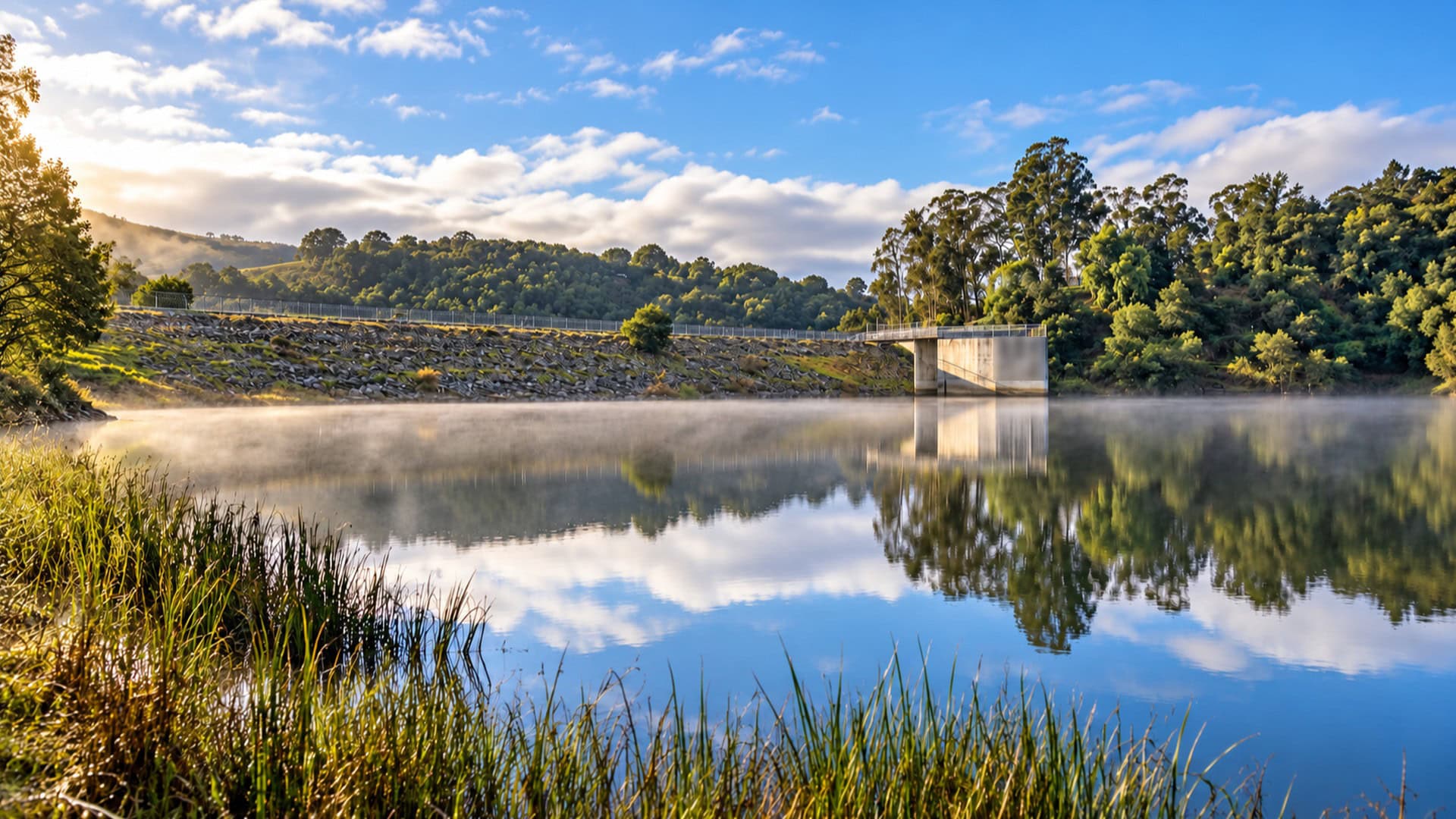
Read the whole post: The camp named for wild horsesYema-po means “wild-horse slope,” and it’s the name archaeologists gave a work camp below Lake Chabot’s dam in San Leandro.
The East Bay Regional Park District’s marker says that in 1979 a renovation of the dam “unearthed a century-old Chinese encampment buried in the creek embankment below.” It was home to the 800 Chinese people who, the marker says, worked on the dam from 1874 to 1892. Cal State East Bay students dug there and recovered “over 60,000 artifacts.” The excavators chose the name, the marker says, to acknowledge “the role of the Chinese laborers in running horses across the dam to compact the soil.” And of the 20,000 animal bones found at the camp, 70% were pig.
The rain was part of the job from the start. In the fall of 1874, the district’s panel notes, “the rains washed out 21,000 cubic yards of the earthen dam wall downstream,” and the dam was rebuilt. A panel the Alameda County Historical Society dedicated at the park remembers “the countless unnamed and unsung Chinese laborers who worked on Lake Chabot Dam.” The Yema-po marker stands on the one-mile Lake Chabot Historical Walk.
It took horses, hundreds of hands and a second try to make that dam hold back the rain. A house has the easier job: the roof sheds the water, and the gutters and downspouts carry it away, as long as the leaves aren’t in the way. Btw, if you’d rather not do the running around on your own roof, we’ll gladly take it on (no horses needed… 😉 Sunshine Gutters and Roofing – Let us shine on your rainy day.

Culture and history
It’s a Wonderful Night
The City’s calendar lists the annual downtown tree lighting at 5:30pm in Estudillo Plaza on Friday, December 4, 2026, with holiday performances, photos with Santa, holiday train rides, crafts for kids, a holiday market and a toy drive. The downtown organisation’s page called its 2025 celebration the 28th annual.
December 4, 2026, per the City’s calendar, read Oct 14, 2026; the downtown organisation’s page, read Oct 20, 2026, shows the 2025 edition on Friday, December 5, 2025
The Cherry Festival
The San Leandro Cherry Festival, in Historic Downtown on West Estudillo Avenue, has a vendor market of over 150 booths, a car show and a parade, the downtown organisation’s page says. The Chamber’s 2019 brochure says to come downtown “the first Saturday in June”; the 2027 date is not posted yet.
The downtown organisation’s page for the 2026 festival lists the 2026 pie winners, so the festival was held; read Oct 14 and 20, 2026. The Chamber’s brochure dates from 2019
See 15 more
The San Leandro depot museum
The San Leandro Historical Railway Society’s schedule page lists its regular hours as every Saturday from 10:00 am to 2:30 pm, and says the Society may be closed on national holidays such as Christmas if they fall on a Saturday. The depot’s story is in The story of San Leandro, below.
Schedule page, copyright 2026, read Oct 20, 2026
The Bal Theatre
San Leandro Curtain Call Performing Arts, a nonprofit, now holds the Bal Theatre’s long-term operating lease, its page says. The theatre’s opening is in The story of San Leandro, below.
Page undated; read Oct 14, 2026
The Casa Peralta
The Casa Peralta is the City’s historic house museum. The City’s page says the house is closed until further notice, and that its grounds can be rented for outdoor weddings. The house’s story is in The story of San Leandro, below.
Pages undated; read Oct 14 and 15, 2026
The Casa Peralta’s roof and gutters
The Historical Society’s restoration campaign says the roof, gutters and downspouts of the Casa Peralta need to be replaced to prevent leaks and water damage.
Pages undated; read Oct 14 and 15, 2026
The San Leandro History Museum
The City’s page says the San Leandro History Museum’s timeline begins with the first people, the Ohlone, and follows the changes through World War II. The page lists the museum’s hours as “Wednesdays and Thursdays for pre-scheduled school tours”. A second City page, Hours & Location, lists the hours as Wednesdays and Thursdays from 1:00 pm to 4:00 pm and the first Saturday of each month from 11:00 am to 4:00 pm, with admission “Free”, at 320 W. Estudillo Avenue (read November 5, 2026, undated); the two pages differ, so call before you go.
City pages read Nov 5 2026 (both undated)
The first people
The Ohlone are the first people in San Leandro’s story. More in The story of San Leandro, below.
Pages undated; read Oct 14 and 15, 2026
A name from a rancho
The Historical Society says the town is named for Estudillo’s Rancho San Leandro. More in The story of San Leandro, below.
Page undated; read Oct 14, 2026
The Little Brown Church
The Little Brown Church was built as the First Presbyterian Church in 1867. More in The story of San Leandro, below.
Pages undated; read Oct 14, 2026
The 1868 earthquake
The City’s hazards chapter says the 1868 earthquake on the Hayward Fault “changed the course of the City’s history”. More in The story of San Leandro, below.
Hazards chapter updated 2025
The county seat
San Leandro was once the Alameda County seat, the Historical Society says. More in The story of San Leandro, below.
Page undated; the Society’s pages differ on the year San Leandro became the seat
The Portuguese Capital of the West
The town’s moniker, the Portuguese Capital of the West, comes from its large Portuguese population. More in The story of San Leandro, below.
Page undated; read Oct 14, 2026
The Cherry City, 1909
A bumper cherry crop in 1909 led to a festival and to the nickname the Cherry City. More in The story of San Leandro, below.
Page undated; read Oct 14, 2026
Where Caterpillar began
Caterpillar’s own account says the Caterpillar Tractor Co. was “initially headquartered in San Leandro, California.” More in The story of San Leandro, below.
The maker’s own page; read Oct 14, 2026
The dahlia
The City’s museum page says the dahlia was designated the city’s official flower. More in The story of San Leandro, below.
Pages undated; no council act has been found
City of Sunshine and Flowers
By the 1930s the town was calling itself the City of Sunshine and Flowers, the Historical Society says. More in The story of San Leandro, below.
Page undated; read Oct 14, 2026
Community
San Leandro Historical Society
The Society says its volunteers are “committed to exploring, sharing, and preserving the stories and structures of our diverse community”. Its events page lists a self-guided Architecture & Home Tour held on a Saturday in May, the 4th annual on May 10, 2025, and no tour for 2026.
Pages undated; the events page prints the 2025 tour as May 10, 2025; read Oct 14 and 20, 2026
Downtown San Leandro Community Benefit District
The district was formed in 2013; it covers about thirty whole or partial blocks, generally bounded by Alvarado Street on the west, Santa Rosa Street on the east, San Leandro Creek on the north and Castro Street on the south. Its page describes downtown as a place with “over 65 unique restaurants” and says it is just three short blocks from BART.
Pages undated; the figures are the organisation’s own
See 7 more
San Leandro Chamber of Commerce
The Chamber dates itself from 1923, and its page lists State of the City, Taste of San Leandro, Restaurant Week and the Best of San Leandro awards among its signature events.
Read Oct 14, 2026
San Leandro Dahlia Society
The Society says it is “a group of people who love dahlias and want to share that love with the world.” It holds an annual dahlia show; its 2026 show was at the Gardens at Lake Merritt in Oakland, and its page does not post the next one.
Pages undated; the Society’s page calls the 2026 show a success; read Oct 14 and 20, 2026
San Leandro Historical Railway Society
The Society has built model railroad displays and gives railroad safety lectures to 6th graders in the San Leandro public schools.
Pages undated; read Oct 14, 2026
Friends of San Leandro Creek
The City’s Tree Master Plan says there are ongoing efforts, such as the work of the nonprofit Friends of San Leandro Creek, to restore and enhance the environmental, recreational and cultural value of the creek.
Plan completed December 2024; read from the Council’s scanned copy
Bay-O-Vista Improvement Association
The San Leandro Times of July 9, 2026 reports that the Bay-O-Vista Improvement Association paid $25,000 to commission a wildfire-evacuation study of the neighborhood.
San Leandro Times, July 9, 2026
San Leandro Public Library
The City’s page says the San Leandro Public Library has been serving its community since 1906. The History Room on the Main Library’s second floor is a local-history collection; the City’s page says its materials are for Library use only and “cannot be checked out.”
Pages undated; read Oct 15, 2026
San Leandro Times
The paper’s masthead reads “AN INDEPENDENT HOMETOWN NEWSPAPER SERVING SAN LEANDRO, ASHLAND, SAN LORENZO AND SHEFFIELD VILLAGE”.
Masthead of the issues of July 9 and September 2026
City rules and regulations
A permit comes before the work
The City’s building code, section 105.1, says any owner or authorized agent who intends to construct, enlarge, alter, move or demolish a building “shall first make application to the Building Official and obtain the required permit.” The list of work that needs no permit, in section 105.2, has fourteen building items, and none of them names roofing, re-roofing or gutters. The City’s page on unpermitted work restates the permit rule and carries the same list. The City’s FAQ page lists “Reroofs” among the construction work that does not need to go through Plan Review, a different step from the permit.
Code read Oct 14, 2026; the City’s pages Oct 15; the FAQ line was asked twice and the page now returns block pages
What a permit’s fee is based on
The code says the value used to work out the building permit and plan review fees is the total value of all construction work, finish work and roofing included. The City’s Fees page names a “Building Permit Fee Schedule 2025-26” and a “Building / Fire Permit Fee Schedule 2026-27”, both PDFs on the City’s site. A proposed Master Fee Schedule for fiscal year 2025-26, attached to a Council staff report, lists “Residential 1 and 2 Family Re-roof” as a permit, per permit. The City’s Master Fee Schedule for July 1, 2026 to June 30, 2027 lists “Residential 1 and 2 Family Re-roof” at $656 per permit for the main dwelling roof, and $328 per permit for detached garages and accessory structures on the same property done at the same time as the main dwelling roof.
City fee schedule read Nov 5 2026
See 18 more
Work without a permit
The code says that when work that needs a permit “has been commenced without first obtaining said permit, the Building Official may impose a penalty” “in an amount equal to three (3) times the amount of the building permit fee”. It also says the investigation fee “shall be equal to the amount of the building permit fee required by this Code.”
Code read Oct 14, 2026; the investigation-fee sentence read once
Roof class on a re-roof
A search of San Leandro’s Municipal Code chapters 3-21 (fire severity zones) and 7-5 (building code) for roof, wildland and Chapter 7A found no roof covering class of the City’s own. The State’s document on the zones says CBC Chapter 7A applies to “new buildings located in High and Very High FHSZs in Local Responsibility Areas” and that “Local ordinances may require ignition resistant construction for remodel projects.” Which class a San Leandro re-roof needs is a question for the City’s Building Division.
Municipal Code read Nov 5 2026
Who can get a permit, and how
The City’s Building and Safety Division page says building permits can only be issued to a California-licensed contractor or a property owner. The City’s page says applications start in the Online Permit Portal, that work cannot begin until the permit is issued, and that after you pay the application fee staff ask for 3 business days to review the submittal.
Pages undated; read Oct 15, 2026
Inspections
The City’s Inspection Services page says inspections are required for all permitted work, are scheduled online by the contractor or the homeowner, and asks for two business days’ advance notice. The code lists ten required inspections, and none of the ten headings names a roof or re-roof inspection.
Page undated; read Oct 15, 2026; the code’s headings read once
Which codes the City applies
The City’s Building Codes page says the City’s building codes are in Title 7, Chapter 7-5 of the Municipal Code, that the current codes went into effect on January 1, 2026, and that they include the 2025 California Building Code, the 2025 California Residential Code and the 2025 California Fire Code. It adds that the State and the City have modified the codes with additional requirements based on local conditions, and that the structural provisions have been modified to address earthquake design standards. The City Council’s meeting record lists Ordinance 2025-016 as passed on December 1, 2025, and the ordinance says its effective date is January 1, 2026; its Article 8 adopts the 2025 California Fire Code as the City’s fire code. The City’s Fire Services page still links the 2016 edition, an older link.
Pages undated; read Oct 15, 2026
A failing roof covering
The City’s Property Maintenance Code counts “Deteriorated or ineffective waterproofing of exterior walls, roof, foundations, or floors” and “Broken, rotted, split, or buckled exterior wall coverings or roof coverings” among the conditions that make a building substandard when they endanger the life, health, property, safety or welfare of the public or the occupants.
Read Oct 14, 2026
Construction debris
The City’s Permits page says that starting January 1, 2023, all residential and commercial projects must “recycle and/or salvage for reuse a minimum of 65% of nonhazardous construction and demolition waste”, send recycling receipts to the inspector before the permit is finaled, and include the City’s worksheet with the permit application.
Page undated; read Oct 15, 2026; the rule’s own text, the State’s green building code and the City’s Chapter 3-7, was not read
Where roof water may go
A search of the Municipal Code’s Storm Water Management and Discharge Control chapter (3-15) and its Uniform Wastewater Discharge Regulations chapter (3-14) for roof, downspout and gutter found no rule on where roof water or downspouts must drain; the only gutter in them is the street gutter, in the chapter’s definition of the City’s storm water system.
Municipal Code read Nov 5 2026
Street trees belong to the City
The City’s code makes every street tree the property of the City, and says it is unlawful, a public nuisance and an infraction, punishable by up to a $1,000 fine, to plant, remove, prune, injure or destroy one except as the chapter allows.
Code read Oct 14, 2026
When a City tree lifts your sidewalk
The Administrative Code’s sidewalk section says that when a street tree lifts a sidewalk the City “will, at its cost, root prune the tree involved”, and that for a vertical offset of 1 1/2 inches or more the City will repair the affected area by removal and replacement and bear 50% of the cost of those repairs. Any additional repairs or improvements the owner asks for, the section says, “must be made at the property owner’s expense.”
Section read Oct 14, 2026 (history line: Res. No. 2023-112, 7/17/2023)
Your sidewalk and planting strip
The City’s page says property owners are responsible for ensuring that the sidewalk in front of their house is not obstructed by landscaping and is clear of weeds and other debris, and for maintaining any land between the back of the curb and the sidewalk.
Page undated; read Oct 15, 2026; the chapter it cites was not read
Private trees
The City’s Tree Master Plan of December 2024 reviews the City’s tree codes and records no protected-tree or heritage-tree rule and no incentives. The plan proposes adopting a heritage tree ordinance, with a target year of 2026. The Municipal Code, which eCode360 shows as including legislation through Ord. No. 2026-009 adopted July 20, 2026, has a Street Trees chapter (5-2) in its Title 5 and no heritage tree chapter there.
Tree Master Plan of December 2024; Municipal Code read Nov 5 2026
Trash, litter and trimmings
The City’s page says the accumulation of litter, debris, trimmings or trash on any property, including the public right of way, which is generated on, or as a consequence of the use or maintenance of the property, is the responsibility of the property owner.
Page undated; read Oct 15, 2026
Accessory dwelling units
The City’s ADU page says accessory dwelling units can be on residentially zoned properties, including single-family, duplex or multifamily properties, and that permitting an ADU requires its own permit, separate from any other work occurring on the main house.
Page undated; read Oct 14, 2026
Older homes and historic review
The Municipal Code’s Historic Preservation chapter (4-26) says: “No person shall alter the exterior of a designated historic resource unless a certificate of approval has been issued in accordance with this Chapter. Nothing in this Chapter shall be construed to prevent the ordinary maintenance and repair of any exterior architectural feature on any designated historic resource that does not involve a change in the character-defining features of the designated resource.” It applies to designated resources.
Municipal Code read Nov 5 2026
When you buy or sell Sewer lateral certificate at a sale
The City’s FAQ page says: “At this time, a sewer lateral compliance certificate is not required.”
FAQ page read Oct 15, 2026 (asked twice; the page now returns block pages)
When you buy or sell If your street is in the Oro Loma district
The Oro Loma Sanitary District’s program page says that all properties sold within the district must have a valid Sewer Lateral Compliance Certificate, for sales that enter escrow on or after August 1, 2026, and that the certificate costs $450. It says certificates are valid for up to 10 years, or 20 years after a full replacement. The district’s home page says its service area includes portions of the City of San Leandro; the program page does not name San Leandro. The page lists no streets, so a seller checks an address with the District.
Effective August 1, 2026; read Oct 14 and 20, 2026; District about page read Nov 3 2026
When you buy or sell The State’s sale-time fire document
The City’s zone page says: “Property sellers must disclose FHSZ designations during real estate transactions.” The Alameda County Fire Department’s FAQ says: “In California, a Defensible Space Real Estate Disclosure is required for residential property sales in high or very high fire hazard severity zones. This means the seller needs documentation of a compliant Defensible Space Inspection for the property.” The City’s 2025 maps have Moderate and High zones.
City page read Nov 5 2026; Department FAQ read by Oct 7 2026
Need a hand with this? Roofing
Storms, flood and drainage
Sand and bags
The City’s Storm Information page says sand and bags are available to San Leandro residents at the Public Works Service Center on Chapman Road “from October 1st through April 1st each year”, with a limit of 10 bags per household. Bags must be filled by the resident with sand outside the gate, and residents with disabilities can obtain pre-filled sandbags there.
Page undated; read Oct 14 and 15, 2026
Before the rains
The City’s Storm Information page says that before winter rains its crews inspect problem flood areas and clear debris to minimize storm drain blockages. It asks residents to check drainage systems and remove debris as necessary, and to clear leaves and debris from storm drain inlets with a rake or shovel. The City’s street sweeping page adds: “From November through January, debris volumes increase significantly due to seasonal leaf fall.”
Storm Information page undated, read Oct 15, 2026; street sweeping page undated, read Nov 5 2026
See 7 more
Adopt a Drain
The City’s Adopt a Drain page says San Leandro residents and businesses can help prepare for rainstorms by adopting one or more drains near their home or business, and that an adopted drain is marked with a special medallion. It asks for “A monthly commitment to check the drain and remove the debris on top”, a task for a street drain, not roof or gutter work.
Page undated; read Oct 14, 2026
Flooding calls
The City’s page says: “Do not call 911 to report flooding unless rising water poses an immediate threat to life or safety.”
Page undated; read Oct 15, 2026
Where the City puts the 100-year flood zones
The City’s hazards chapter says the areas within the 100-year flood zones include land adjacent to San Leandro Creek, San Lorenzo Creek and the Estudillo Canal; land along flood control channels in the vicinity of Bayfair Center and Bonaire Park; and coastal areas surrounding Oyster Bay Regional Shoreline, the San Leandro Shoreline Park and Heron Bay. The City’s Floodplain Management page says that as of December 21, 2018, FEMA updated local flood zones following a coastal study. For the flood zone of your own property, the City’s flood maps page says: “If you have questions regarding flood zone information for your property, please contact the Division of Building and Safety’s Flood Information Line at 510-577-3416” and have the street address ready; the page also says the City “is the repository for flood maps.”
Hazards chapter updated 2025; the Floodplain Management page undated, read Oct 15, 2026; the flood maps page undated, read Nov 5 2026
Remodeling in a flood zone
The City’s page says that if your home is below the 100-year flood elevation, the City’s flood damage prevention regulations may affect how you remodel, renovate or add on to it, and that a substantial improvement is any reconstruction, rehabilitation, addition or other improvement “the cost of which equals or exceeds 50% of the market value of the structure”.
Page undated; read Oct 15, 2026; the Municipal Code chapter behind it was not read
Where the water goes: the Estudillo Canal
The Flood Control District says the 9.4-square-mile Estudillo Canal Watershed, located entirely within the city of San Leandro, drains west through a network of canals and underground culverts in residential and commercial areas of the city, and that the canal connects to the Heron Bay tidal marsh through a tide gate.
Page undated; read Oct 14, 2026
Landslides on the hillsides
The City’s hazards chapter says: “Landslides are relatively common in the East Bay Hills, especially during high intensity rainstorms. Most slides occur naturally, but they may be exacerbated by excessive grading, improper construction, and poor drainage.” It says the San Leandro Hills have a history of destructive landslides.
Hazards chapter updated 2025; read Oct 15, 2026
Private trees in a storm
The City’s Storm Information page says clean-up of privately owned trees and branches is the responsibility of the owner, whether the clean-up is on the owner’s property or neighboring property, including City property, and that private trees should be properly trimmed and maintained in advance of storm season.
Page undated; read Oct 15, 2026
Need a hand with this? Gutter cleaning
Programs, loans and insurance
Check back City earthquake retrofit workshop: check back
The City’s Building and Safety Services Division runs a Home Earthquake Strengthening Course; its Retrofit Workshop page says the workshop “reviews common residential construction weaknesses and introduces basic retrofit techniques” and that “By the final work session, the homeowner will have completed a plan set to bolt and brace their home to its foundation.” The page says the workshop “consists of four 2-hour classroom sessions”, from 6 to 8 pm, at $30 for a single resident and $35 for a couple; non-residents pay $50 and $60. The City’s September 3, 2026 notice says the course is “geared towards owners of older, raised-floor homes”. The Retrofit Workshop page says the series is provided “on a quarterly basis”, while the City’s Retrofit Programs page says three times a year, in March, July and October; the dates it lists, March 12, 17, 19 and 24, carry no year. To be placed on the waitlist for future classes, the page asks for an e-mail to permitsbyemail@sanleandro.org with the names of all persons attending, the address, a phone number and an e-mail address.
Retrofit Workshop page read Nov 5 2026
Free retrofit plan set and tool lending library
The City’s Retrofit Plan Set page says: “The Prescriptive Plan Set (PDF) is free to any San Leandro resident or contractor working on a San Leandro retrofit project.” The City’s Earthquake Retrofit Programs page says its Tool Lending Library “allows workshop attendees to borrow, free of charge, most of the tools they may need to complete the retrofit job.” With the plan set filled out, the homeowner can take it to the City’s Permit Center, apply for a building permit, pay a fixed home-retrofit permit fee and then be ready to start the work. The City’s Master Fee Schedule for July 1, 2026 to June 30, 2027 lists “Residential Seismic Retrofit projects using ‘Plan set A'” at $83 per permit.
City fee schedule read Nov 5 2026
See 18 more
Check back City home repair grants and rehabilitation loans: check back
The City’s Information and Referral page lists “Home Repair Grants/Housing Rehabilitation Loans” under “City of San Leandro – Housing Programs”, with a Housing Division phone line. The City’s Housing Programs page says: “Rebuilding Together Oakland/East Bay ceased operations on March 31, 2024 and is no longer accepting applications. The City’s housing rehabilitation program is on hold until further notice.”
City Housing Programs page read Nov 5 2026
Green House Calls: free home energy and water assessments
The City’s Conserve Water at Home page says the City of San Leandro partners with Rising Sun Center for Opportunity to provide Green House Calls to San Leandro residents, with no-cost home energy and water assessments. At each call, the page says, specialists check the home for efficiency and install energy and water-saving equipment such as energy-efficient lighting, high-efficiency aerators, showerheads, clotheslines and power strips; no roof, gutter or drainage item is on the list. Rising Sun’s page describes Green House Calls as “Energy and Water Efficiency Support for Homeowners and Renters” for “households throughout the Greater Bay Area and Central California” and asks you to complete an online form; the page we read states no income test.
Rising Sun page read Nov 5 2026
EBMUD rebates and free water-saving devices
EBMUD’s rebates page says its rebates are available to both residential and non-residential customers with potable water service. It lists a Lawn Conversion Rebate of up to $2.00 per sq. ft., a Treebate Pilot Rebate of up to $100, a Landscape Design Assistance Program Rebate of $200, Efficient Irrigation Rebates, a Flowmeter Rebate of up to $200, a Graywater Rebate of up to $100, and free Mulch and Compost Coupons and Water-Saving Devices; no rain barrel or cistern rebate is on the page. The City’s Conserve Water at Home page says EBMUD “offers water conserving showerheads and faucet aerators at no cost to San Leandro water customers.”
Page undated, read Oct 14, 2026
Habitat for Humanity home repair, roofs included
Habitat for Humanity East Bay/Silicon Valley’s Home Repair page lists San Leandro among the Alameda County places where its services are currently available, and names “roof repairs, upgrading electrical systems, replumbing, flooring replacement, replacing windows” among its critical repairs. The page says the program “preserves homeownership for low-income residents”, and that “All home repairs are performed by licensed contractors and overseen by our skilled construction staff.” It lists Home Repair Orientation sessions on Tuesday, November 10 and Tuesday, December 8, 2026, both at 1 p.m., each described as a “30-minute, online presentation”. The page gives no income limits and no cost to the homeowner.
Habitat page read Nov 3 2026
County-wide Check back Renew Alameda County home improvement loans: check back
Renew Alameda County’s page says: “Renew Alameda County’s application is currently closed, but you can still join the interest list.” The program is operated by Habitat for Humanity East Bay/Silicon Valley, and its page says it is for low-income homeowners “within the county’s 20-city territory”; the list of eligible repairs includes “Re-roofing and gutter replacement” and “Property Drainage Improvements”. The program’s home page says it provides “1% interest loans from $15,000 to $200,000”, while the County’s page says the loans are “between $15,000 and $150,000”, an open difference between the two pages. The City of San Leandro’s Housing Programs page lists Renew Alameda County among its homeownership programs. The pages we read do not list the 20 cities. Habitat’s Pleasanton page says the loan program is “open for enrollment”, which differs from the program’s own page, an open difference.
Program page read Nov 3 2026; City page read Nov 5 2026
County-wide Free weatherization for income-qualified households (Spectrum)
Spectrum Community Services’ Low Income Weatherization Assistance Program lists “Heater Replacement, Water Heater Replacement, Attic and Floor Insulation, Window and Exterior Door Repair or Replacement, Low-flow Showerheads and Faucet Aerators, Fridge Replacement or Repair, Range Replacement or Repair, Weather-Stripping, Energy-Saving Light Bulbs, Smoke Detectors and Carbon Monoxide Alarms, Microwaves”; no roof, gutter or drainage item is on the list. To qualify you must “Live in Alameda County. Provide a complete PG&E bill or other electric & gas bill. Provide proof of monthly income for the entire household”, and “Own the residence or get approval from the owner for weatherization services.” Its income table, headed “2026 Weatherization Gross Income Guidelines” (“Income before taxes are deducted.”), lists monthly limits of $3,331.66 for 1 person and $6,407.16 for 4 people; the page lists the other household sizes. The page says: “Priorities are placed on households with seniors (60+), disabled, and children under 6.” Heater, water heater, and weatherization services are available “every five years.”
Page updated 30 December 2025; read Oct 7 and 20 2026
BayREN EASE Home: weatherization for moderate-income homes
BayREN’s EASE Home page says: “BayREN covers 80% of the cost for essential weatherization upgrades, including insulation and duct sealing.” To qualify you “Have a household income under or at 120% AMI.”, “Live in a single-family home (four or fewer units) built before 2010.” and “Are a PG&E customer.”; Alameda is on the page’s list of nine counties. The page adds that “all participants must use a BayREN partner contractor.” The City’s Energy Upgrade Your Home page lists the program too, “with BayREN covering 80% of the cost of core weatherization and energy efficiency measures”.
Page footer 2026; read Oct 7 and 20 2026
County-wide Check back Lead paint hazard repair grants: check back
The Alameda County Healthy Homes Department’s lead paint hazard repair grants are “Grants of up to $12,000 per unit for lead paint hazard repair work.” The work listed includes safely repainting deteriorated lead-based paint, repairing conditions such as rubbing doors that contribute to lead hazards, replacing damaged components such as rotted siding or windows that have deteriorating lead-based paint, landscaping over bare lead-contaminated soil and specialized cleaning of lead dust; roofs and gutters are not named. The page says: “Properties must be pre-1960 residential property in Alameda County.” Owner-occupied units “must be home to a child under six years old or a pregnant person, or be regularly visited by a child under six at least 2 visits per week of at least 3 hours each visit.” The Department’s page says it is “accepting pre-applications for lead hazard repair funding and developing an interest list of properties for when additional funds become available.”
Department page read Nov 5 2026
Check back PG&E Energy Savings Assistance: check back
PG&E’s page says the program lets you “Upgrade or repair heat pump water heaters, furnaces, lighting-even refrigerators.” “All at no charge.*” It says participants must live in a house, mobile home or apartment that is at least five years old. PG&E’s service-area page lists San Leandro under Alameda County in both its electric and its gas service territories. PG&E’s page, read November 5, 2026, has an “Apply for ESA” button and says its income guidelines are valid through May 31, 2027; it says renters and homeowners can take part.
PG&E page read Nov 5 2026
Check back Free Energy Saving Toolkit: check back
BayREN’s page says Rising Sun Center for Opportunity delivers the toolkit through the Green House Calls program in partnership with BayREN; the kit lists energy efficient light bulbs, water-saving aerators, advanced power strips or smart plugs, LED nightlights, weatherstripping tape and window film. The page says: “Eligibility for our services is on a ‘while supplies last’ basis and only for addresses that have not received Rising Sun’s services within the last 5 years.” No roof, gutter or drainage item is on the list.
Read Oct 7 2026
State-wide Check back Earthquake Brace + Bolt: check back
The California Residential Mitigation Program’s page says Earthquake Brace + Bolt “provides up to $3,000 toward a code-compliant seismic retrofit to a qualifying house.” Eligibility is by ZIP code: the 2025 list for Northern California names San Leandro with 94577, 94578, 94579 and 94580 (94580 is also listed under San Lorenzo); the page’s own date is “As of January 15, 2025”. The page says an EBB retrofit “is only done on wood-framed, pre-1980 homes with a raised foundation.” For the supplemental grant the page defines an “income-eligible household” as “a household with income at or below $94,480.” It says supplemental grants “may pay up to 100 percent of the cost of the retrofit as long as funds are available”, and that registration “is open for a limited time each year”. Its page offers “Sign Up to be Notified When Registration Opens”. The page, read November 5, 2026, shows no open registration: it says “When EBB registration is open, you can complete the registration form online.”
Page read Nov 5 2026
State-wide Check back California Safe Homes: check back
The Department of Insurance’s December 30, 2025 release says the grant program will “assist qualifying residents in obtaining new or replacement fire-safe roofs and implementing fire-safe mitigation measures within five feet of their homes”. The Department of Insurance’s list of 2026 press releases, read November 3, 2026, has no release announcing that applications are open.
Department page read Nov 3 2026
County-wide Check back Diablo Firesafe Council cost-share: check back
The Diablo Firesafe Council’s page says: “DFSC has temporarily closed the applications for the Partners in Wildfire Prevention fuel reduction grant match.” The page says DFSC may assist “Alameda County or Contra Costa County property owners with vegetation management projects”, with “Up to $3,500” of cost-share funds. The page, read November 3, 2026, still says so.
Council page read Nov 3 2026
County-wide Diablo Firesafe Council home hardening talk
The Diablo Firesafe Council says it offers “a free program called Five Easy Actions, an informative, 90-minute hands-on talk to discuss home hardening for your FIREWISE group.” The program page names no town; the council’s home page names Alameda and Contra Costa counties.
Council pages read Nov 3 2026
Check back Clean HEET wood stove and fireplace insert replacement: check back
The Air District’s program page says: “The Clean HEET Program application period closed on July 14, 2026.” Its residents page says to join the email mailing list to receive alerts when the program launches, so the two pages disagree on whether it has closed or is still to launch. The program gives funding to replace freestanding wood stoves and wood-burning fireplace inserts with electric heat pumps, and the Air District says: “All Bay Area homeowners are eligible to apply.”
Page last updated 7/14/2026; read Oct 7 and 20 2026
Alameda County Fire Department’s free community chipper program
The Department’s FAQ says it is offering “a free community chipping service” and that “Piles of leaves, pine needles or yard clippings cannot be chipped.” The FAQ names no area and no dates; it says neighborhoods are encouraged “to organize to schedule a day for chipping”, and the sign-up form is on the Department’s chipper page.
Department FAQ and page read Nov 3 2026
Insurance The City in the National Flood Insurance Program
The City’s 2011 hazard annex says the City of San Leandro has participated in the National Flood Insurance Program since 1974.
The City’s 2011 account
Insurance The City’s place in FEMA’s flood insurance rating
FEMA’s Community Status Book for California, dated 10/07/2026, lists San Leandro in Community Rating System class 8, 10 percent.
Read by Oct 7 2026 (county sheet)
Who serves your home in San Leandro
- Fire: The Alameda County Fire Department, which provides the City’s fire protection under contract.
- Water: East Bay Municipal Utility District: its page on its Orinda treatment plant lists San Leandro among the places the plant serves “all or parts of”. The District’s service-area page says the area runs from Crockett on the north south to San Lorenzo and names no San Leandro street, so its pages cannot say which San Leandro addresses are EBMUD customers.
- Sewer: The City’s Water Pollution Control Division serves the northern two-thirds of San Leandro, the City’s Sewer Services page says. The Oro Loma Sanitary District’s page says its service area includes portions of the City of San Leandro. The District’s about page says its service area includes “designated areas of the Cities of Hayward and San Leandro” and carries a map of the District; the page lists no streets, so the map is where to check one.
- Garbage: The City’s page names two residential garbage and recycling haulers, Alameda County Industries and Waste Management of Alameda County, and says San Leandro has two distinct geographic areas for these services. Alameda County Industries says it is the franchised hauler for San Leandro, excluding the Oro Loma Sanitary District. The City’s page links a map of the two service areas (PDF), and says the City keeps no public records of the franchise between the Oro Loma Sanitary District and Waste Management of Alameda County.
- Electricity: Ava Community Energy’s page says Ava “is the default electricity provider for residents, businesses, and municipal accounts in most of Alameda County and San Joaquin County”, and its table of Alameda County cities lists San Leandro. Ava’s About page says: “We supply electricity to all accounts (residential, business, and municipal) and PG&E delivers it.”
- Gas: PG&E’s service-area page lists San Leandro under Alameda County in its Gas Service Territory.
- Air: The Bay Area Air District’s coverage line names Alameda County among its nine counties. Its wood-smoke page says: “Wood burning will be banned throughout the year when a Spare the Air Alert is called due to high levels of fine particulate pollution from sources such as residential wood smoke or wildfires.”
- Flood control: The Alameda County Flood Control and Water Conservation District, in two of its numbered areas, 9 and 12: its pages list “San Leandro (partial)” for each.
- Storm drains: The City’s Public Works Department owns and maintains 175 miles of storm drainage conduits that feed the District’s larger system, the City’s 2017 plan says.
- Permits: The City’s Building and Safety Division, with the Online Permit Portal for applications.
- Property tax appeals: The Alameda County Clerk’s Assessment Appeals page says the Clerk’s unit “receives and processes assessment appeal applications”. The County Assessor’s own site was not read.
- Schools: The San Leandro Unified School District, with its office in San Leandro; its enrollment page sends a family to a street-address search to see whether the address is inside the district’s boundaries.
- Parks: The City’s Parks page says San Leandro has “23 parks and recreation facilities”; the East Bay Regional Park District runs Oyster Bay Regional Shoreline, which has a San Leandro address, and Lake Chabot Regional Park, which its page says is reached from I-580 in San Leandro by exiting at Fairmont Drive.
Useful links: San Leandro Unified School District · City of San Leandro: Storm Information (sand and bags) · City of San Leandro: Building and Safety Division and the Online Permit Portal · City of San Leandro: fire hazard zone maps and the address viewer · Alameda County Fire Department · East Bay Municipal Utility District · Oro Loma Sanitary District · Alameda County Flood Control and Water Conservation District (areas 9 and 12) · City of San Leandro parks and the San Leandro Shoreline · East Bay Regional Park District (Lake Chabot and Oyster Bay Regional Shoreline) · San Leandro Public Library and History Room · San Leandro Historical Society · Downtown San Leandro · San Leandro Chamber of Commerce · San Leandro Times · City of San Leandro: Get Connected (AC Alert and Nixle)
The homes of San Leandro
San Leandro’s median home was built in 1959. About 52.5 percent of its housing units were built before 1960 and about 76.8 percent before 1980, and about 57.3 percent are single-family detached homes and 2.4 percent are mobile homes, our own calculations from the Census Bureau’s 2020-2024 tables. The City’s General Plan says most neighborhoods south and west of Downtown date from the 1940s and 50s, and its hazards chapter says about 10 percent of the City’s housing stock pre-dates 1940.
1860
The Peralta Home
The National Park Service file’s 1978 account says the Peralta Home, now the Alta Mira Club’s clubhouse, was built in 1860 and stuccoed over in 1875 “to prevent further moisture damage”.
The form describes it as originally “a symmetrical three-bay hipped roof classic Italianate red brick building with central portico and pronounced eave bracketing.”
1880 to 1910
Dabner’s Addition
The City’s 2015 housing papers, in a survey table, describe the Dabner’s Addition survey area as an “Eclectic mix of 1880-1910 homes and newer homes and flats.”
Early 1900s to the 1930s
Northeast neighborhoods and stucco bungalows
The City’s 2015 housing papers say many neighborhoods in the northeast part of the city, such as Broadmoor and Estudillo Estates, were developed in the first 40 years of the 20th century, and the General Plan says Best Manor and Farrelly Pond are characterized by single-story stucco bungalows dating from the 1920s and 1930s.
1940s and 1950s
Post-war neighborhoods
The 1950s are the largest decade of building, with 8,415 housing units, 26.3 percent, and the 1940s and 1950s together account for 13,239 units, 41.4 percent, our own calculation from the Census Bureau’s 2020-2024 tables.
Around 1950 to the early 1960s
Little Alaska and Marina Faire
The General Plan says Little Alaska was developed around 1950, with Alaskan cities providing the inspiration for its street names, and that Marina Faire includes about 475 homes developed in the early 1960s.
The 1990s
Cherrywood and Heron Bay
The General Plan says Cherrywood, about 350 homes, was built on former nursery lands in the 1990s, and calls Heron Bay one of three adjoining developments on the west side of Wicks Boulevard.
Today
Few new homes
Only about 6.5 percent of the housing units were built since 2000, our own calculation from the Census Bureau’s 2020-2024 tables.
Older roofs and gutters need a different hand: Gutter Repair · Roof Repair · Gutter Installation
The story of San Leandro
History and character
The Historical Society says the area we now call San Leandro is in the traditional homeland of the Ohlone people.
The Historical Society says San Leandro gets its name from Estudillo’s Rancho San Leandro, which took its name from El Rodeo de San Leandro, Mission San Jose’s cattle round up area, named for Saint Leander, a sixth-century Spanish bishop.
The First Presbyterian Church, built with old-growth redwood, the Historical Society says, was dedicated on April 28, 1867; today it is the Little Brown Church, and in 1979 the city council let it be moved behind the Casa Peralta, only a block away.
The City’s hazards chapter says the 1868 earthquake on the Hayward Fault “destroyed many buildings in San Leandro and changed the course of the City’s history when it destroyed the Alameda County Courthouse in the center of town”. The USGS’s 2008 field guide says San Leandro was one of the most heavily damaged communities in that earthquake.
San Leandro was incorporated in 1872.
The Historical Society says the Western artist Edward Borein (1872-1945) was born in San Leandro.
The Historical Society says San Leandro was the Alameda County seat until 1873, when the seat moved to Oakland and San Leandro “veered onto a quieter path.”
By the late 1800s, the Society says, San Leandro had factories producing tractors, combines, hay presses and other farm equipment, as well as a cannery to preserve local produce.
The Historical Society says San Leandro’s large Portuguese population in the late 19th and early 20th centuries earned the town the moniker the Portuguese Capital of the West. It says some of the early settlers were from the Portuguese Azores, and many more arrived after economic depression in Hawaii in the 1890s left the Portuguese sugar industry workers without jobs.
The San Leandro depot was built in 1898 to replace the original depot built by the Central Pacific Railroad, and it was used for passengers until the Second World War, when the passenger agency was closed as a “non-essential” service. The San Leandro Historical Railway Society was formed in 1988 to purchase the depot, and moved it to its current site in Thrasher Park on December 11, 1988.
In 1901, the Society says, a new American Colonial Revival style home was built on the site of today’s Casa Peralta, and the house was later remodeled as a Spanish-style villa with hand-painted tiles imported from Spain. In 1969, when it was in danger of being torn down for development, two buyers bought it and donated it to the City of San Leandro, the Society says.
In 1909, to celebrate a bumper crop of cherries, the town decided to hold a cherry festival, which established San Leandro as the Cherry City, the Society says, and cherry festivals have been held off and on ever since.
In 1925, Caterpillar’s own account says, the Holt Manufacturing Company and the C.L. Best Tractor Co. merged to form the Caterpillar Tractor Co., “initially headquartered in San Leandro, California.”
The San Leandro Dahlia Society held its first show in 1925, according to its own page. The City’s museum page says: “In time, the dahlia was designated the city’s official flower.” The Historical Society’s photo gallery says dahlias were named the official San Leandro flower in 1927.
The first San Leandro High School opened at Bancroft and Estudillo Avenues in 1926, the school district’s page says, and the school’s pages say it is celebrating its centennial, 1926-2026.
By the 1930s, the Society says, floriculture was replacing farm fields and the town began to call itself the City of Sunshine and Flowers; later it billed itself as the “City of Industry”. In the 1930s, the district’s page says, San Leandro changed from an agrarian to a residential community, with subdivisions replacing cherry orchards.
The Bal Theatre opened on July 1, 1946, with 800 seats.
After the war, the Society says, many farm fields were sold to developers, who built housing for the new arrivals, and the population continued to swell in the 1950s and 1960s; the annexation of surrounding fields and multiplying subdivisions “completed the transition from orchards to suburb.”
San Leandro, roof and gutters
San Leandro sits between the Bay and the hills. The City’s 2017 plan says the city is bound on the north by Oakland and on the south by the unincorporated communities of San Lorenzo and Ashland, with San Francisco Bay defining its western edge and the East Bay hills its eastern edge. The same plan says the city lies on the East Bay Plain, about three miles wide in this area, which at its eastern edge rises into low hills, to 526 feet at the highest point in the Bay-O-Vista neighborhood.
The eastern edge of the City is crossed by the Hayward Fault, the City’s General Plan chapter on environmental hazards, updated in 2025, says. On Fairmont Drive, the USGS’s 2008 field guide says, the fault offsets a curb and follows a linear valley.
Yearly rain runs from 18.68 inches at Oakland Metro International Airport to 25.25 inches at Upper San Leandro Filters, the two nearest federal weather stations, by our own calculation from NOAA’s 1991-2020 normals. The City’s tree-care page gives the rainy season as November to April and the dry season as May to October; at both stations November to April holds about 90 percent of the year’s rain, and July is the driest month, with 0.00 inch.
The City’s Storm Information page says: “Storm drains have limited capacity and flooding may occur in low lying areas and/or at high tide during an initial downpour based on the severity of the storm.” The City’s Creeks and Bay page says that after a rain storm all the water flows to the nearest creek, and that some of the City’s creeks run above ground, like San Leandro Creek by Bancroft Middle School, while others run in underground culverts with storm drain openings along the streets.
The City’s Tree Master Plan page says the public trees along streets and in parks were inventoried by ISA Certified Arborists in 2022. The plan, which the City’s page says was adopted on January 6, 2025, counts crapemyrtle (1,787 trees) and London planetree (1,708) as the most common species in the inventory, each about 10 percent of it. It names sweetgum, sycamore and London planetrees as litter-prone trees that “drop litter and branches throughout the year.”
The age of San Leandro’s homes is told in The homes of San Leandro, above.
A San Leandro mailing address does not always mean inside the city limits: the City’s 2015 housing papers say that properties with San Leandro addresses include several in unincorporated Ashland and Hillcrest Knolls, to the southeast of the City limits.
We have been working on Bay Area roofs and gutters since 2002. If yours hasn’t had a look in a while, we’d be glad to come by.
Landmarks and parks
Casa Peralta
The City’s historic house museum.
Little Brown Church
The home of the San Leandro Historical Society.
Bal Theatre
An Art Deco movie and performing-arts house.
San Leandro Depot
Now a railroad museum in Thrasher Park.
San Leandro History Museum
City-owned, next to the Casa Peralta.
San Leandro Shoreline
The City’s Shoreline page lists Marina Park’s two playgrounds, a one-mile par course and an off-leash dog park, a Bay Trail section, and hundreds of acres of restored seasonal wetlands.
Lake Chabot Regional Park
A 315-acre reservoir built in 1874-75 and closed to recreation for 91 years; the park district opened Lake Chabot Regional Park on June 18, 1966.
Oyster Bay Regional Shoreline
A shoreline park under development just south of Oakland International Airport, the park district’s page says, with seven group picnic areas.
How we can help in San Leandro
Why Sunshine Gutters and Roofing
- Family-owned since 2002, trusted by thousands of returning Bay Area homeowners
- Licensed (CSLB #1053780), bonded, with $2 million in general liability coverage
- Our own crew, never subcontractors
- We keep track of local regulations, fire safety rules and insurance programs
- We show you what we found, with photos, so you decide what happens next
The year in San Leandro
| April | Sandbag season ends April 1, by the City’s Storm Information page Rainy season ends in April, by the City’s tree-care page Farmers market on Wednesday nights from April to mid-October, at the Main Library |
|---|---|
| June | Cherry Festival and Parade, downtown, on the first Saturday in June by the Chamber’s brochure (the 2027 date is not posted yet) |
| July | No rain in July: 0.00 inch at both of the nearest federal weather stations |
| October | Sand and bags are available from October 1 at the Public Works Service Center |
| November | Rainy season: November to April holds about 90 percent of the year’s rain at the two nearest federal weather stations |
| December | It’s a Wonderful Night, the downtown tree lighting (2026: December 4) |
San Leandro questions
What San Leandro homeowners ask us
Do I need a permit to replace my roof in San Leandro?
To replace it, yes: the City’s building code requires a permit before anyone alters a building, and its list of work that needs no permit has no roofing item. Article 1 of the building code never uses the word re-roof, but the City’s proposed fee schedule for 2025-26 lists a “Residential 1 and 2 Family Re-roof” permit. The City’s adopted fee schedule for July 1, 2026 to June 30, 2027 puts the main dwelling roof at $656 per permit. If you wish, we can also pull the permit for you, as most of our customers ask us to.
Is my home in a fire hazard severity zone in San Leandro?
Check your address in the City’s Interactive Map Viewer; the City’s page on the 2025 zone maps says that is where you can enter your address and check which zone your property is in. The City’s page says CAL FIRE’s 2025 update added High and Moderate zones and eliminated the Very High zones. The City’s hazards chapter says CAL FIRE has designated the eastern edges of the Bay-O-Vista neighborhood and the Daniels Drive area as within the High or Moderate Fire Hazard Severity Zone.
What happens if I do work without a permit in San Leandro?
The City’s building code says that whenever work that needs a permit “has been commenced without first obtaining said permit, the Building Official may impose a penalty” “in an amount equal to three (3) times the amount of the building permit fee”. The code also says the investigation fee “shall be equal to the amount of the building permit fee required by this Code.”
Where can I get sandbags in San Leandro, and how many?
The City’s Storm Information page says sand and bags are available to San Leandro residents at the Public Works Service Center on Chapman Road from October 1st through April 1st each year, with a limit of 10 bags per San Leandro household. Bags must be filled by the resident with sand outside the gate, and residents with disabilities can obtain pre-filled sandbags there.
What our customers say









Get a free estimate
We usually respond promptly within the day. Phone first for emergencies: (510) 525-0880.
Where we work
San Leandro neighbourhoods we serve


Downtown San Leandro
The General Plan says the traditional Downtown Core includes the area along East 14th Street and Washington Avenue between San Leandro Creek and Sybil Avenue/Castro Street.
Bay-O-Vista
The part of San Leandro east of I-580, the General Plan says, unique among San Leandro neighborhoods because of its hilly topography and panoramic views.
Washington Manor
The General Plan calls Washington Manor and Bonaire well-established neighborhoods in southwest San Leandro.
Bonaire
Floresta
The General Plan says the Floresta/Springlake area extends west from I-880 to Hesperian Boulevard in the southern part of San Leandro.
Halcyon
The General Plan calls the Halcyon-Foothill area one of the largest and most diverse residential areas in San Leandro, extending almost three miles south and southeast from Downtown to the Bay Fair area.
Broadmoor
Estudillo Estates
Best Manor
Cherrywood
Mulford Gardens
Laid out in the 1920s as a rural subdivision in unincorporated Alameda County and annexed to San Leandro in 1957, the General Plan says, it still retains a semi-rural quality.
Marina Faire
Also serving nearby: Oakland · Ashland · San Lorenzo · Castro Valley