

Gutters and Roofing for Piedmont
Gutter and roof installation, cleaning, repairs and rejuvenation. Family-owned since 2002, trusted by thousands of returning Bay Area homeowners.
Piedmont, in short
How old are the homes in Piedmont?
Mostly old ones. By our own calculation from the Census Bureau’s 2020-2024 tables, about 63 percent of Piedmont’s homes were built in 1939 or earlier, and so was the median home. The City’s General Plan says some 2,500 homes went up between 1907 and 1940, “nearly 70 percent of the city’s existing housing stock”.
The story of Piedmont
Piedmont, “foot of the mountain” in Italian, a small city of its own inside Oakland.
Walter Blair became the first settler in the Piedmont hills in 1852, and mineral springs and a hotel drew visitors in the years after. After the 1906 earthquake San Franciscans moved east, and Piedmont incorporated as a city in 1907. Within two years Oakland had annexed the land to the east and north, and Piedmont has been an island inside Oakland ever since.
In 1820, the City’s General Plan says, the Spanish governor of California granted title to more than 40,000 acres in the East Bay to Don Luis Maria Peralta; the grant, Rancho San Antonio, was divided among his four sons in 1842, and the area from Piedmont to the north went to Jose Domingo Peralta.
In 1850 Colonel John C. Hayes built a wagon road along what is now Moraga Avenue, to reach land he had acquired in the Oakland Hills immediately above what is now Piedmont.
In 1852, the Historical Society says, Walter Blair became the first settler in the Piedmont hills; he bought some 600 acres at $1.25 an acre.
Blair set up a dairy on what is now Highland Avenue and started a quarry on the site of present-day Dracena Park, the City’s General Plan says.
The Piedmont Springs Hotel opened in 1871 for visitors who came for the mineral springs, and it burned down in 1892.
In 1877 Blair sold 350 acres to James Gamble, president of Western Union Telegraph, who built a home on Hillside Avenue and, with partners, created the Piedmont Land Company; its first auction of lots took place on April 10, 1877.
Landscape engineer William Hammond Hall was hired to plan the avenues and subdivide the tract into 67 parcels.
In the 1880s Walter Blair opened Blair Park, where families could “spend a pleasant day rambling in the country”.
In 1890 cable cars replaced Walter Blair’s horse cars and played an important role in bringing visitors and future residents into Piedmont.
Frank C. Havens developed Piedmont Park in 1898 to keep visitors coming, and the City’s General Plan says he built a restaurant and clubhouse, paths and bridges, an art gallery and an outdoor theater for musical performances.
A number of prominent writers and artists, Jack London among them, settled in the city around 1900, the General Plan says.
After the 1906 earthquake and fire in San Francisco, many refugees fled to Oakland and Piedmont, and the General Plan says the earthquake triggered a population boom in Piedmont.
Piedmont incorporated as a city in 1907; Hugh Craig and James Ballentine led the effort.
Craig and Ballentine used the Piedmont Sanitary Sewer District map to set the city limits, which bisected many existing lot lines; the City says the line between Piedmont and Oakland still bisects over 100 properties, and the school district says that on some streets one side is in Oakland and the other in Piedmont.
Within two years, the General Plan says, Oakland annexed all the land to the east and north of the city, effectively landlocking Piedmont and making it an “island” within the Oakland city limits.
The Bonita Avenue School, built in 1910, was the first public school in Piedmont, and Ellen Driscoll was its first principal and taught there for 20 years.
In 1920 residents voted on “the two most important events” in the city’s history, to establish a high school and to acquire Piedmont Park, and Piedmont High School opened in 1921.
Piedmont has been a charter city since 1923, in the City’s words.
Albert Farr’s Exedra and Community Hall, the first phase of a 1922 master plan, were dedicated on April 3, 1925, and some elements of the plan, including a streetcar tunnel under Highland Avenue, were never built.
By 1960 Piedmont was essentially built out, with only scattered vacant lots remaining; most of those were developed in the 1960s and 1970s.
In 2007 Piedmont celebrated its centennial, and the park’s history was commemorated with the dedication of a Centennial trail.
Fire safety
Your fire department
The Piedmont Fire Department says it is here 24/7 to protect Piedmont from fire and disaster and to respond to medical emergencies. Its main line is (510) 420-3030, its 24-hour non-emergency dispatch line is (510) 420-3000, and in an emergency you call 9-1-1.
City page read Oct 7 2026
A free wildfire inspection
The Fire Department will visit your home and inspect your property for wildfire safety, at no cost. Its staff review what you have already done and recommend steps, short-term and long-term, to reduce the risk. A typical inspection takes about 30-45 minutes. The City’s page says inspections are generally voluntary, and that in some circumstances the Department may contact you to inspect your property even if you did not request it. To ask for one, call (510) 420-3030.
City page read Oct 25 2026
See 4 more
The whole city is a Wildland Urban Interface area
The City Code designates the entire city a Wildland Urban Interface (WUI) area. Every property in it must comply with the building construction and vegetation management requirements of the adopted WUI Code, and a violation of the vegetation standards is a public nuisance subject to abatement that may also be enforced by an administrative fine. That is the City’s own designation under its Code.
Code section history note: Ord. 787 N.S., 12/2025
Clear the roof, the gutters and the ground
The City’s yard page says: “Clear leaves, pine needles, and other debris from roofs, gutters, and the ground.” It adds: “Remove all dead plants, grass, and weeds around your property.” and, for owners of eucalyptus: “If you have Eucalyptus trees, remove shedding bark and leaves.” The page asks you to “Review your property every September to make sure it’s prepared for fire season.” Grass must be trimmed.
City page read Oct 25 2026
Branches over the roof
The City’s yard checklist asks owners to “Remove branches that hang over your roof.” and to “Remove branches within 10 feet of your chimney.” It also asks you to trim trees so that the lowest branches are at least 6 feet from the ground, or 3 times the height of any shrubs beneath the tree. Street trees by the curb are the City’s to prune.
City page read Oct 25 2026
Hardening steps on the City’s page
The City’s home hardening page lists steps such as covering exterior vents with “1/16 to 1/8 inch non-combustible, corrosion-resistant metal mesh screens”, installing soffits under the eaves “with non-combustible or ignition resistant materials”, and upgrading windows with multi-paned glass or shutters. It also asks owners not to keep any combustible building within 30 feet of the home, sheds, gazebos and accessory dwelling units among them.
City page read Oct 7 2026
Need a hand with this? Gutter guards
-
From the Piedmont blog
The quarry that struck water
Read the whole post: The quarry that struck waterDracena Park has a story at the bottom of its bowl. It used to be a quarry, until the quarry struck water.
Walter Blair noticed rock on his Piedmont land, and Oakland needed rock. His quarry’s crushed stone went “to pave the dusty streets of Oakland and Piedmont,” as the Piedmont Historical Society puts it.
In the 1870s the crew went deeper. An 1896 San Francisco Chronicle account tells what happened next. A big charge was set, and with the blast “a vast torrent of water sprouted forth from the excavation.” The workmen were knee-deep before they knew it, and they got the mules out with difficulty. “So sudden was the deluge that within an hour where once stood a prosperous quarry nothing was to be seen but a rising mass of water.” Big pumps pulled out thousands of gallons, and the water kept rising. The quarry was abandoned, its loaded cars still on the tracks.
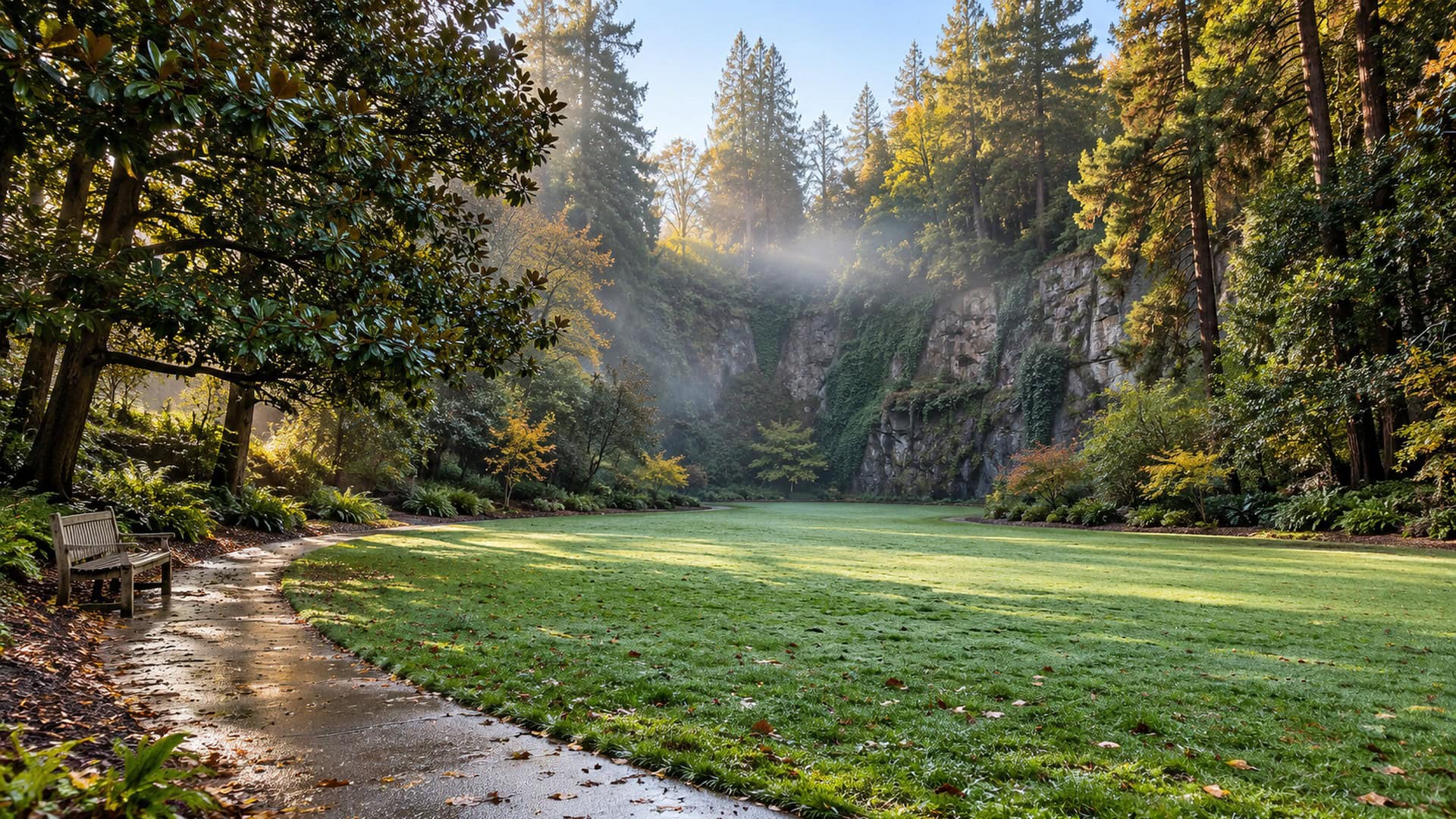
For years it was a pond. By 1927 part of it had been filled to hold a park department greenhouse, growing more than 10,000 plants a year. Later it was a city work yard. In the 1990s the City turned it into a park, and in 1996 it dedicated the lawn at the bottom. Behind the tall green gates, the old quarry walls still rise at the far end of what the City calls its “secret garden.”
Water still finds its way through Piedmont. The City says Pleasant Valley Creek begins in Dracena Park, and that the town’s creeks are fed by springs, rainwater and runoff. Before storms it asks every household to clean “gutters, rain downspouts, driveways, and culverts.” A lot of that rain starts on the roof. If, for any reason, you prefer to delegate that job, we are always happy and honored to do it.

Culture and history
A name that means foot of the mountain
Piedmont’s name, the City says, means “foot of the mountain” and reflects its hillside setting. More in The story of Piedmont, below.
The Fourth of July parade
The parade began in 1965, the Historical Society says, and the City calls it “one of Piedmont’s most beloved traditions”, with local dignitaries, civic organizations, sports teams, classic cars and bagpipe bands marching eight blocks along Highland Avenue.
City notice of June 16, 2026; held every July 4
See 5 more
The Harvest Festival
The City’s annual Harvest Festival in Piedmont Park is free and open to everyone, with an Edibles Contest, a jazz festival, an art show, Scarecrow Alley, a farmers’ market and food trucks.
City event page read Oct 25 2026
Lights Up!
Piedmont’s annual celebration of light kicks off the winter holiday season with the illumination of the 80-foot redwood tree, a menorah lighting, latkes, cider and hot cocoa, and photos with Santa Claus inside Community Hall. It is free and everyone is welcome, and the City’s Events page lists it for December 2, 2026, at 7 pm.
City Events page read Oct 25 2026
The Exedra and Community Hall
Albert Farr’s formal entrance to Piedmont Park and the Mediterranean-style Community Hall behind it, both completed in 1925. More in The story of Piedmont, below.
The Wetmore House
The one house in Piedmont on the National Register of Historic Places, next to City Hall. More in The story of Piedmont, below.
An island inside Oakland
Oakland surrounds Piedmont on all sides, and the line between the two cities splits some lots and runs down the middle of some streets. More in The story of Piedmont, below.
Community
Piedmont Historical Society
A non-profit that actively promotes preservation in the city, the City’s General Plan says, with a collection of Piedmont memorabilia in the Piedmont Recreation Center. A small group of historians proposed it in January 1972, and it publishes a yearly newsletter, Piedmont’s History.
Piedmont Garden Club and Beautification Foundation
The Piedmont Garden Club, founded in 1923, proposed the Piedmont Beautification Foundation in 1964, a trust with the City that funds the beautifying of parks, the Community Center, street plantings and other civic improvements. The Foundation also supports Lights Up! each year.
See 3 more
Piedmont Center for the Arts
Its mission is to enable artists and students in music, dramatic arts, visual arts and literature to perform and display their work for residents of Piedmont and surrounding communities.
The Piedmont Exedra
The Piedmont Exedra describes itself as “a free, hyperlocal, independent news site created by a group of Piedmont citizens” and launched in November 2018.
Park Commission and the Heritage Tree Program
A seven-member Park Commission advises the City Council on the maintenance and improvement of city parks, and on planting, removal and maintenance of street trees. The City Council created the Heritage Tree Program on the Commission’s recommendation on January 16, 2018, and a City notice of February 6, 2026 says this year’s class will join 34 others designated since the program began.
City notice posted February 6, 2026
City rules and regulations
Roof permit and inspections
The City has a roof building permit that you apply for online on its eTRAKiT system, and its fee schedule lists a re-roof permit among the over-the-counter permits. The application asks for the roof color, and the page says that if it is light color or reflective, “it will require design review”. The City also asks for a contractor or owner-builder declaration with every project. The City’s inspection page warns: “If you don’t get inspections, your permit could be revoked and you may need to stop your project.”
Pages read Oct 25 2026; fee schedule effective January 1, 2026
Roof material and design review
The City Code requires a design review permit for an improvement that needs a building permit, and the City will not issue the building permit until the applicant has the design review permit. The City’s list of projects that need no design review includes a change of roof material, as long as the new material is not a light or reflective color or surface, for changes such as wood shingles, wood shakes or tar and gravel to composition shingles, with all sloped roofs on the property consistent.
Page read Oct 25 2026
See 7 more
Gutters, downspouts and normal upkeep
The City’s list of projects that need no design review also includes “New or relocated wood or metal gutters and downspouts that are painted to match the existing structure or trim color, and new or relocated unpainted copper gutters and downspouts.” It lists “Normal repairs, replacement and maintenance of existing construction, so long as there is no change in the materials, design and size of the feature being repaired or replaced.”
Page read Oct 25 2026
Wood shingles and shakes
The City Code says: “The installation of wood shingles is prohibited.” and, in the next section, “The installation of wood shakes is prohibited.” Each has an exception for repair or replacement of existing wood shingles or shakes on dwellings and accessory structures on, or eligible for inclusion on, the National Register of Historic Places.
Rooftop solar
For a small residential rooftop solar energy system, the City Code says the Planning & Building Department “will issue a building permit within three business days of receipt of a complete application” that meets the requirements of the approved checklist and standard plan.
Street trees are the City’s
A street tree is any tree growing in the parking strip between the curb and the sidewalk, and the vegetation on public property is owned by the City. The Code says: “No person shall prune a tree in a parking strip or in another city right-of-way.” Removing a street tree needs the Park Commission’s approval after a hearing, and unauthorized pruning, treatment, removal or damage is subject to a fine of $1,000 per violation, with each branch over one inch in diameter at the cut counted as a separate violation. To report a street tree that needs immediate attention, call (510) 420-3050.
Trees and views
A Piedmont property owner “shall have the right to establish a view claim and obtain restorative action” under the Code’s view section, and the Code leaves enforcement to “the private parties involved”. Work required under a view resolution must be done by a certified arborist.
Where roof water may go
Piedmont’s plumbing rules say roofs “must be drained into a separate storm sewer system or to some other place of disposal satisfactory to the Authority Having Jurisdiction.” The Code makes it unlawful to discharge roof runoff into a building sewer lateral or public sewer, and says no area drains, foundation drains or roof leaders may connect to the lateral. The City’s permit page, read November 5, 2026, says: “Site drainage permits include area drains, foundation drainage, stormwater and downspout connections.” It adds: “You need an encroachment permit from Public Works if your project: Includes work in the public right of way, Discharges additional stormwater to the street.”
Code sections read Oct 2026; permit page read Nov 5 2026
When you buy or sell What a seller hands the buyer
Each person who sells or transfers an interest in real property in Piedmont must give a prospective buyer three items. The first is a property records search from the Planning & Building Department, for a nominal fee set by the City Council, showing the building permit history for the property and which improvements were approved. The second is a disclosure statement prepared by the Planning & Building Director. The third, for a low-rise residential building, is a Home Energy Score or a Home Energy Audit made no more than five years before the property is advertised or listed, unless the home was built within the ten years before.
Code history note: Ord. 751 N.S., 02/2021
Need a hand with this? Roofing
Storms, flood and drainage
Free sandbags
Piedmont residents can get 10 free sandbags per household at the City’s Corporation Yard on Red Rock Road, Monday-Friday, 7am-3:30pm. The City suggests them if your home is in the path of runoff: “get sandbags to divert water and debris.”
Page undated, read Oct 25 2026
Clean on and around your property
Before a storm the City asks owners to “Clean on and around your property as needed: gutters, rain downspouts, driveways, and culverts.” It also asks you to keep the drainage system on your street clear of debris, and says that some preparations take time, like pruning trees, while others, like clearing a storm drain in front of your house, can be done quickly.
Page undated, read Oct 25 2026
See 5 more
Leaves and street flooding
The City’s hazard plan says localized flooding “occurs regularly after heavy rains” and that, with more than 8,000 street trees, “the ongoing accumulation of vegetation and leaves will need to be continuously addressed to alleviate localized flooding.”
Street sweeping
The City says: “Street sweeping keeps our storm drains clear during leaf drop season.” Its General Plan says it publishes a street sweeping schedule during the rainy season so that residents can plan accordingly, and the City asks you to move your car and any other obstacles off the street before scheduled sweeping.
Page read Oct 25 2026
When the street floods
The City’s General Plan element says that in very heavy rains localized street flooding may occur where storm drainage flows exceed the capacity of an inlet or pipe, and that the City maintains these facilities regularly. The City’s Clean Water Program adds: “Only rain belongs in the storm sewer system.”
Landslides on the slopes
The City’s Environmental Hazards Element says the risk of landslides generally corresponds to slope, with the highest hazards in Moraga Canyon, along Indian Gulch, in Piedmont Park, in the Wildwood Gardens area, along Park Boulevard and in the Somerset Road area along the Oakland border, and that landslide hazards in the rest of the city are generally low. It adds that there is still the potential for slope instability resulting from improper construction and poor drainage.
Check the flood map for your address
Need a hand with this? Gutter cleaning
Programs, loans and insurance
Home electrification rebates
The City of Piedmont offers cash rebates to property owners who replace gas appliances with electric alternatives. The program relaunched July 1, 2026, and the City’s rebates now include $800 for a heat pump water heater (up to $2,000 for income-qualified households), $2,000 for solar paired with a battery (up to $5,000), $900 for a main electrical panel upgrade or smart panel (up to $2,250), and $2,500 for gas meter removal for all eligible households. Heat pump heating and cooling rebates are limited to income-qualified households. Rebates are first-come, first-served and funding is not guaranteed, and the application goes in within four months of the permit issue date (for gas meter removal, within one year of the date on PG&E’s shut-off confirmation letter).
City pages read Oct 25 2026
Electrification rebates: who qualifies
Households earning 120% or less of Alameda County’s area median income can qualify for the moderate-income tier, and households that qualify for CARE or FERA for the low-income tier. The City’s guide gives income limits for a household of one of $54,100 (low-income) and $136,750 (moderate-income), and for four people of $82,500 and $195,350; the guide lists the other household sizes.
Guide read Oct 7 2026
See 9 more
Free brown leaf bags
If you have extra yard waste, you can put it in compostable bags with your weekly curbside waste, and the City gives out free 33-gallon bags. Pick them up at the Planning & Building office in City Hall, Monday to Thursday during business hours, or call Republic Services at (800) 320-8077 and it will mail them (postage fees apply).
City page read Oct 25 2026
Free compost
Free compost is available at the City’s Corporation Yard on a first-come, first-serve basis; bring your own shovel, container and gloves. The site is closed if it is raining or muddy, and the City cannot guarantee compost every day.
City page read Oct 25 2026
County-wide Habitat for Humanity home repairs
Habitat for Humanity East Bay/Silicon Valley lists Piedmont among the Alameda County places where its home repair services are available. The City’s Housing Programs page says Habitat offers a program in Piedmont to make repairs that improve a homeowner’s health, safety and quality of life, and financial assistance for repairs to eligible homeowners.
City page read Oct 25 2026
County-wide Check back Renew Alameda County: check back
The City’s Housing Programs page lists the Renew Alameda County loan program for home repair projects over $15,000, and the program’s own page says “APPLICATIONS NOW CLOSED” and invites you to join its interest list.
Program page read Oct 24 2026
County-wide Check back Diablo Firesafe Council cost-share: check back
The Council’s cost-share program helps Alameda County and Contra Costa County property owners pay for vegetation work toward their fire department’s defensible space requirements in its priority hazard areas. Its page says: “Up to $3,500 of cost-share funds is available to reduce your fire risk.” and that its applications are temporarily closed (update of May 2025).
Program page read Oct 24 2026
Check back Earthquake Brace + Bolt: check back
Earthquake Brace + Bolt is run by the California Residential Mitigation Program, and eligibility is by ZIP code only: the program’s 2025 ZIP list gives 94610 and 94611 for Piedmont. The City’s 2024 notice said homes must have been built before 1980, have a raised continuous perimeter concrete foundation and sit on level ground or a low slope. The program’s page invites you to sign up to be notified when registration opens.
ZIP list of 2025, read Oct 7 2026
County-wide Weatherization and lead paint repair help
Spectrum Community Services’ weatherization program lists attic and floor insulation, window and exterior door repair or replacement, heater and water heater replacement, weather-stripping and more, with no roof, gutter or drainage item; to qualify you live in Alameda County, provide a utility bill and proof of the household’s monthly income, and own the residence or get the owner’s approval. The Alameda County Healthy Homes Department’s page says “Grants of up to $12,000 per unit for lead paint hazard repair work” are available for pre-1960 residential property in Alameda County, and that owner-occupied units must be home to a child under six years old or a pregnant person, or be regularly visited by a child under six; income limits apply.
Pages read Oct 7 2026; the Healthy Homes page shows 2024 income limits
Insurance A letter from your insurer
If you received a letter from your home insurance provider, the City’s wildfire page says to call the Fire Department at (510) 420-3030.
City page read Oct 25 2026
Insurance A vegetation inspection for insurance
If you need a vegetation inspection for insurance purposes, the City’s inspection page says to contact the Fire Department at (510) 420-3030.
City page read Oct 25 2026
Who serves your home in Piedmont
- Fire: The Piedmont Fire Department, the City’s own, protects the city from fire and responds to medical emergencies from one station next to City Hall.
- Water: East Bay Municipal Utility District (EBMUD), which owns and maintains the water pipes in Piedmont.
- Sewer: The City owns and maintains the sewer pipes in the street, and the sewage goes through Oakland to an EBMUD interceptor and treatment plant. The pipe from the house to the street, the private sewer lateral, is the owner’s, EBMUD says.
- Garbage: Republic Services, which the City’s curbside page names for curbside garbage, recycling and compost collection.
- Electricity: Ava Community Energy is the default supplier for most of Piedmont’s residents and businesses, and PG&E delivers the electricity.
- Gas: PG&E, the City’s General Plan element says.
- Flood control: Piedmont is not part of the Alameda County Flood Control and Water Conservation District, the City says.
- Storm drains: The City owns and maintains them; because of the hills, the storm sewer relies on curbs, street gutters and natural drainage as well as pipes.
- Air district: The Bay Area Air Quality Management District, which regulates the nine counties around San Francisco Bay, Alameda among them.
- County Assessor: The Alameda County Assessor’s page on new construction says that “certain construction activities are not subject to reassessment” and lists among them “Normal building maintenance and repair” and “Replacement of worn out items such as a roof or plumbing fixtures.” The Assessor’s main number is (510) 272-3787.
Useful links: Piedmont Unified School District · Piedmont Fire Department (wildfire inspections and the yard checklist) · City of Piedmont: Prepare for storms and free sandbags · City of Piedmont: Street sweeping · EBMUD (water, and the private sewer lateral program) · Republic Services (curbside garbage, recycling and compost) · Ava Community Energy · Piedmont Historical Society · The Piedmont Exedra (local news)
The homes of Piedmont
About 95 percent of Piedmont’s housing units are single-family houses that stand apart, and about 91 percent of its occupied homes are owner-occupied, by our own calculations from the Census Bureau’s 2020-2024 tables. The median home has 8.1 rooms, and about 48 percent of homes have four or more bedrooms. The City’s Design Guidelines claim: “Piedmont has the largest per capita supply of pre-World War II single-family housing in the State of California.”
Before 1907
The oldest homes
Just over 170 existing homes pre-date the City’s incorporation in 1907. The City’s plan says its earliest homes include some of the Bay Area’s best examples of Victorian, Bungalow, American Foursquare, Craftsman, Colonial Revival and English/Tudor residential architecture, with the greatest concentration in Central Piedmont along streets such as Hillside, Bonita, Highland, Mesa and Oakland Avenues.
1907 to 1930
Streetcar suburbs
The City’s plan calls this the dominant neighborhood type in Piedmont: lots of 5,000 to 15,000 square feet with many Mediterranean Revival, Brown Shingle, Tudor, Prairie Style and Colonial Revival homes on a modified street grid.
West of Grand Avenue
Bungalow and cottage neighborhoods
Small lots of less than 5,000 square feet, with a mix of small one-story bungalows and cottages, larger brown-shingle homes, former farmhouses, Victorians and a handful of small apartment buildings; the plan says much of the housing stock there is over 90 years old.
Large lots
Estate neighborhoods
The City’s plan names the Sotelo-Glen Alpine loop and Seaview and King Avenues, where many lots exceed half an acre and are heavily wooded, creating a semi-rural feel.
Steep eastern slopes
Hillside neighborhoods
Winding narrow streets and multi-level hillside homes, many in contemporary styles designed to maximize views, along with some century-old homes from the days when Piedmont was considered “the country” and was home to many artists and writers.
1940s to 1960s
Mid-century ranch homes
St. James Wood and other areas of eastern Piedmont were developed mostly after 1940, with California ranch homes that have open floor plans, post and beam construction and attached two-car garages; one-story construction predominates. About 300 homes were added in the 1940s and another 500 in the 1950s, and single-family zoning kept out the post-war apartment boom that Oakland and Berkeley had.
Today
Renovated and expanded
A majority of Piedmont’s housing stock has been renovated in the past 50 years, the City’s plan says, with many homes undergoing substantial expansion. The Design Guidelines say that when a new roof is part of an addition or remodel it should be consistent with the design integrity of the existing structure, and that the geometry of the new roof should relate to that of the existing roof.
All eras
Roofs in the City’s Design Guidelines
The Guidelines call Piedmont’s range of residential building styles eclectic: “there are rarely two adjacent homes that look alike.” They describe Craftsman homes with a low pitched gable roof, deep overhangs and exposed roof rafters; Mission homes with a low pitched tile roof; Tudor homes with steeply pitched gable roofs; Dutch Colonial homes with a gambrel style roof; and Prairie homes with a low pitched hip roof.
Older roofs and gutters need a different hand: Gutter Repair · Roof Repair · Gutter Installation
The story of Piedmont
History and character
In 1820, the City’s General Plan says, the Spanish governor of California granted title to more than 40,000 acres in the East Bay to Don Luis Maria Peralta; the grant, Rancho San Antonio, was divided among his four sons in 1842, and the area from Piedmont to the north went to Jose Domingo Peralta.
In 1850 Colonel John C. Hayes built a wagon road along what is now Moraga Avenue, to reach land he had acquired in the Oakland Hills immediately above what is now Piedmont.
In 1852, the Historical Society says, Walter Blair became the first settler in the Piedmont hills; he bought some 600 acres at $1.25 an acre.
Blair set up a dairy on what is now Highland Avenue and started a quarry on the site of present-day Dracena Park, the City’s General Plan says.
The Piedmont Springs Hotel opened in 1871 for visitors who came for the mineral springs, and it burned down in 1892.
In 1877 Blair sold 350 acres to James Gamble, president of Western Union Telegraph, who built a home on Hillside Avenue and, with partners, created the Piedmont Land Company; its first auction of lots took place on April 10, 1877.
Landscape engineer William Hammond Hall was hired to plan the avenues and subdivide the tract into 67 parcels.
In the 1880s Walter Blair opened Blair Park, where families could “spend a pleasant day rambling in the country”.
In 1890 cable cars replaced Walter Blair’s horse cars and played an important role in bringing visitors and future residents into Piedmont.
Frank C. Havens developed Piedmont Park in 1898 to keep visitors coming, and the City’s General Plan says he built a restaurant and clubhouse, paths and bridges, an art gallery and an outdoor theater for musical performances.
A number of prominent writers and artists, Jack London among them, settled in the city around 1900, the General Plan says.
After the 1906 earthquake and fire in San Francisco, many refugees fled to Oakland and Piedmont, and the General Plan says the earthquake triggered a population boom in Piedmont.
Piedmont incorporated as a city in 1907; Hugh Craig and James Ballentine led the effort.
Craig and Ballentine used the Piedmont Sanitary Sewer District map to set the city limits, which bisected many existing lot lines; the City says the line between Piedmont and Oakland still bisects over 100 properties, and the school district says that on some streets one side is in Oakland and the other in Piedmont.
Within two years, the General Plan says, Oakland annexed all the land to the east and north of the city, effectively landlocking Piedmont and making it an “island” within the Oakland city limits.
The Bonita Avenue School, built in 1910, was the first public school in Piedmont, and Ellen Driscoll was its first principal and taught there for 20 years.
In 1920 residents voted on “the two most important events” in the city’s history, to establish a high school and to acquire Piedmont Park, and Piedmont High School opened in 1921.
Piedmont has been a charter city since 1923, in the City’s words.
Albert Farr’s Exedra and Community Hall, the first phase of a 1922 master plan, were dedicated on April 3, 1925, and some elements of the plan, including a streetcar tunnel under Highland Avenue, were never built.
By 1960 Piedmont was essentially built out, with only scattered vacant lots remaining; most of those were developed in the 1960s and 1970s.
In 2007 Piedmont celebrated its centennial, and the park’s history was commemorated with the dedication of a Centennial trail.
Piedmont, roof and gutters
Piedmont is a small, residential city of 1.7 square miles in the East Bay hills, and Oakland surrounds it on all sides. The land rises gently from west to east, from 40 feet above sea level at Wildwood and Grand Avenues to 704 feet at the Corporation Yard on Moraga Avenue, and the City’s plan says the 300-foot contour roughly marks the perceived boundary between upper and lower Piedmont.
Yearly rain averages about 24 inches at the two nearest federal weather stations, the Oakland Museum (22.61 inches) and Berkeley (26.12 inches). The City’s hazard plan says most rain falls from October to April; at those two stations November through April alone brings about 90 percent of the year’s rain, by our own calculation from NOAA’s 1991-2020 monthly normals, with December the wettest month and July the driest.
Almost all of Piedmont drains to Lake Merritt, the City’s plans say, except a narrow strip along Park Boulevard, and the city is about a quarter of the Lake Merritt watershed. The General Plan adds that many creek segments have been rerouted into buried storm drains.
The General Plan names two main soil types: stable, nutrient-rich deposits on the lower, flatter ground, and shallower, clay-like soils that shrink in dry weather and swell in wet weather, which affects how foundations are designed. The City’s hazard element says these hazards are somewhat greater in the eastern part of the city.
The City’s 2023 inventory counts 8,839 trees on its streets and in its parks, led by London planetree (22.3 percent), sweetgum (10.1), maple leaf oak (8.4), Chinese pistache (7.8) and coast redwood (6.2). The General Plan lists leaf litter, sidewalk breakage, view blockage and maintenance as public concerns about street trees. The Forest Service’s review of American sweetgum says “the fruit often persists through the entire winter”, and a North Carolina State Extension page says that in the home landscape the London planetree “requires much maintenance because of the excess litter produced by the twigs, leaves, bark, and fruiting balls”.
We have been working on Bay Area roofs and gutters since 2002. If yours hasn’t had a look in a while, we’d be glad to come by.
Landmarks and parks
Piedmont Park
At about 15 acres, the General Plan’s “crown jewel” and the city’s largest park, with a formal Exedra entry near Highland and Magnolia Avenues and redwoods along its stream banks.
Piedmont Community Hall
A Mediterranean-style hall behind the Exedra plaza; the Recreation Department’s facilities division runs rentals of the hall and the Exedra Plaza.
Piedmont City Hall
Built in 1910 to a design by Albert Farr, it houses the City Administrator’s Office, the City Clerk’s Office, the Finance Department, Public Works, Planning & Building, the Fire Department and the Council Chambers.
Oakland Avenue Bridge
Albert Farr’s Mission-style gateway of 1910, which replaced an 1890 wooden trestle over Linda Avenue; the City says that when it opened it was the largest of the new concrete reinforced spans in the United States.
Wetmore House
The City calls it the oldest residence in Piedmont and the only house on the National Register of Historic Places, listed April 14, 1978; the nomination form puts its construction at about 1878.
Dracena Quarry Park
An informal eight-acre park in an abandoned rock quarry that still keeps its bowl-shaped topography, “a hidden neighborhood gem” in the City’s words.
Crocker Park
A one-acre landscaped park in the estate area, with a shaded lawn, beds of rhododendrons, camellias, azaleas and ferns, and a granite sculpture of a bear and her cubs by Benny Bufano.
Blair Park
A natural, unlandscaped park of over 8 acres along Moraga Avenue, used mainly by dog owners; the City’s parks element calls it the second largest unimproved open space in Piedmont.
How we can help in Piedmont
Why Sunshine Gutters and Roofing
- Family-owned since 2002, trusted by thousands of returning Bay Area homeowners
- Licensed (CSLB #1053780), bonded, with $2 million in general liability coverage
- Our own crew, never subcontractors
- We keep track of local regulations, fire safety rules and insurance programs
- We show you what we found, with photos, so you decide what happens next
The year in Piedmont
| April | The rainy months end: most rain falls from October to April, the City’s hazard plan says |
|---|---|
| July | Fourth of July parade and picnic along Highland Avenue |
| September | The City asks owners to review their property for fire season every September |
| October | The rainy months begin: most rain falls from October to April, the City’s hazard plan says |
| December | Wettest month at the two nearest federal weather stations Lights Up!, the annual celebration of light at Piedmont Community Hall (2026: December 2) |
Piedmont questions
What Piedmont homeowners ask us
Does roof replacement require a permit in Piedmont?
Yes. The City has a roof building permit that you apply for online on its eTRAKiT system, and its fee schedule lists a re-roof permit among the over-the-counter permits; see the City’s fee page for the current fee. The application asks for the roof color, and a light or reflective color “will require design review”. Once the work starts, the cost of the City’s inspections is included in the permit fees. If you wish, we can also pull the permit for you, as most of our customers ask us to.
Does changing my roof material or my gutters need design review in Piedmont?
Not for some changes. The City’s list of projects that need no design review includes a change of roof material, as long as the new material is not a light or reflective color or surface, for changes such as wood shingles, wood shakes or tar and gravel to composition shingles. It also includes “New or relocated wood or metal gutters and downspouts that are painted to match the existing structure or trim color, and new or relocated unpainted copper gutters and downspouts.” A light or reflective roof still goes to design review.
Where should the water from my downspouts go in Piedmont?
Not into the sewer. The City Code makes it unlawful to discharge roof runoff into a building sewer lateral or public sewer, and it says roofs must be drained into a separate storm sewer system or to some other place of disposal that the City finds satisfactory. The General Plan’s policy is that runoff from a property be directed so that it does not threaten the properties next to it, toward places where it can be absorbed into the ground, held in rain barrels or cisterns, or sent to the storm drains; that is a policy, not a code section.
Who can prune the street tree in front of my Piedmont home?
Only the City. The Code says: “No person shall prune a tree in a parking strip or in another city right-of-way.” Only City personnel or agents of the City may trim or prune street trees, and removing one needs the Park Commission’s approval after a hearing. Unauthorized pruning is subject to a fine of $1,000 per violation, and to report a street tree that needs immediate attention you call (510) 420-3050.
What our customers say









Get a free estimate
We usually respond promptly within the day. Phone first for emergencies: (510) 525-0880.
Where we work
Piedmont neighbourhoods we serve


Upper Piedmont
The part above the 300-foot contour, which the City’s plan says roughly marks the perceived boundary between upper and lower Piedmont.
Lower Piedmont
The lower, flatter ground, where the General Plan places stable, nutrient-rich soils.
St. James Wood
The City’s plan names it among the mid-century neighborhoods of eastern Piedmont, with entrance pillars on Park Boulevard.
Piedmont Manor
A tract along Grand Avenue whose entrance pillars the City’s plan names; the Historical Society lists it among the new developments of 1913.
Sotelo-Glen Alpine
The City’s plan names the Sotelo-Glen Alpine loop among its estate neighborhoods, with lots that often exceed half an acre.
Moraga Canyon
The City has a Moraga Canyon Specific Plan for City-owned land here, and Coaches’ Field lies off Moraga Avenue.
Blair/Scenic/Alta
The City’s wildfire page names it as a neighborhood where the Fire Department held a practical evacuation drill.
Civic Center
The blocks bounded by Vista, Magnolia, Highland and Hillside Avenues, where the City’s municipal buildings stand.
The Highlands
The Requa family’s estate, listed as an early house of 1876 in the Wetmore House’s nomination form; the Historical Society says it became forty-two houses after the mansion was demolished in 1923.
Also serving nearby: Oakland