

Gutters and Roofs for Berkeley, from the Bay Flats to the Hills
Gutter and roof installation, cleaning, repairs and rejuvenation. Family-owned since 2002, working in Berkeley.
Berkeley, in short
Do you have to keep the roof and gutters clear in Berkeley’s hills?
Yes. Under the City’s wildland-urban interface code of December 2025, roofs and rain gutters in the Very High Fire Hazard Severity Zone must be kept clear of leaves, needles and other plant material. Berkeley Fire’s address lookup shows which wildfire risk area your address is in.
The story of Berkeley
A college town named for a poem, from the Bay flats to the hills.
Long before the town, the East Bay was home to the Chochenyo-speaking Ohlone. In 1866 trustees of the College of California chose the name Berkeley, after a poem by George Berkeley. The campus opened in 1873, and the settlement around it later merged with Ocean View on the waterfront.
The Chochenyo-speaking Ohlone lived across the East Bay; the stretch from Richmond to Oakland was called Huchiun. At the mouth of Strawberry Creek, Indigenous people built the first of some 425 shellmounds that eventually surrounded the Bay.
In 1820 Luís María Peralta received Rancho San Antonio, bounded on the north by Cerrito Creek; in 1842 his son José Domingo got the part that takes in today’s Berkeley and Albany.
The settlement near the Bay was Ocean View. Bowen’s Inn of 1853 is a City landmark, and the 1855 starch and grist mill began West Berkeley’s life as an industrial district.
Trustees met on May 24, 1866 at the rock later called Founders’ Rock and named the town. The University was chartered in 1868 and its Berkeley campus opened in 1873.
From 1900 to 1930 new neighbourhoods grew along the Key System and Southern Pacific electric lines; the town hall of 1909 is today’s Old City Hall.
On September 17, 1923, in the Berkeley Historical Society’s words, “Wildfire destroyed nearly 600 homes and other buildings in North Berkeley and for a time threatened the whole city.”
Bernard Maybeck, John Galen Howard and Julia Morgan shaped the city; in the City’s 2002 account, the Arts and Crafts response gave Berkeley “a particular architectural distinction”.
New Deal agencies built the Rose Garden and the Berkeley Marina, and federal workers built Tilden Park. When the Bay Bridge opened in 1936 the ferry ended and the pier passed to the City.
In 1964, in the society’s words, “The Free Speech Movement exploded on the Cal campus.”
In 1961-62 three Berkeley women founded Save the Bay; Chez Panisse opened in 1971 on North Shattuck; in the 1990s the City built the Addison Street arts district around Berkeley Rep.
Fire safety
Find your wildfire risk area
Berkeley Fire’s address lookup shows which wildfire risk area your address is in.
Updated Oct 7, 2026
A free defensible-space inspection
Berkeley Fire inspects each year, March to November, in the two hill areas; the first inspection has no fee. The City’s wildfire inspections page also says, “Inspections are required for all properties in the Grizzly Peak and Panoramic Mitigation Areas as well as other residents who also live in the Very High Fire Hazard Severity Zone.” It says residents in the highest wildfire risk areas “can schedule an annual inspection”, and to enter your address on Berkeley FireSafe to find your wildfire risk area.
Updated Oct 7, 2026; the City page read Nov 5, 2026
See 2 more
Hill homes: keep roofs and gutters clear
The City asks hill-area residents to remove fallen debris on the ground, roof and in gutters.
Wildfire risk is greatest in two hill areas
The City’s code names the Grizzly Peak Mitigation Area (east of Grizzly Peak Boulevard) and the Panoramic Mitigation Area (Panoramic Hill), both in the wider Very High Fire Hazard Severity Zone. Some older City pages still call the hill areas fire zones 2 and 3.
Need a hand with this? Gutter guards
-
From the Berkeley blog
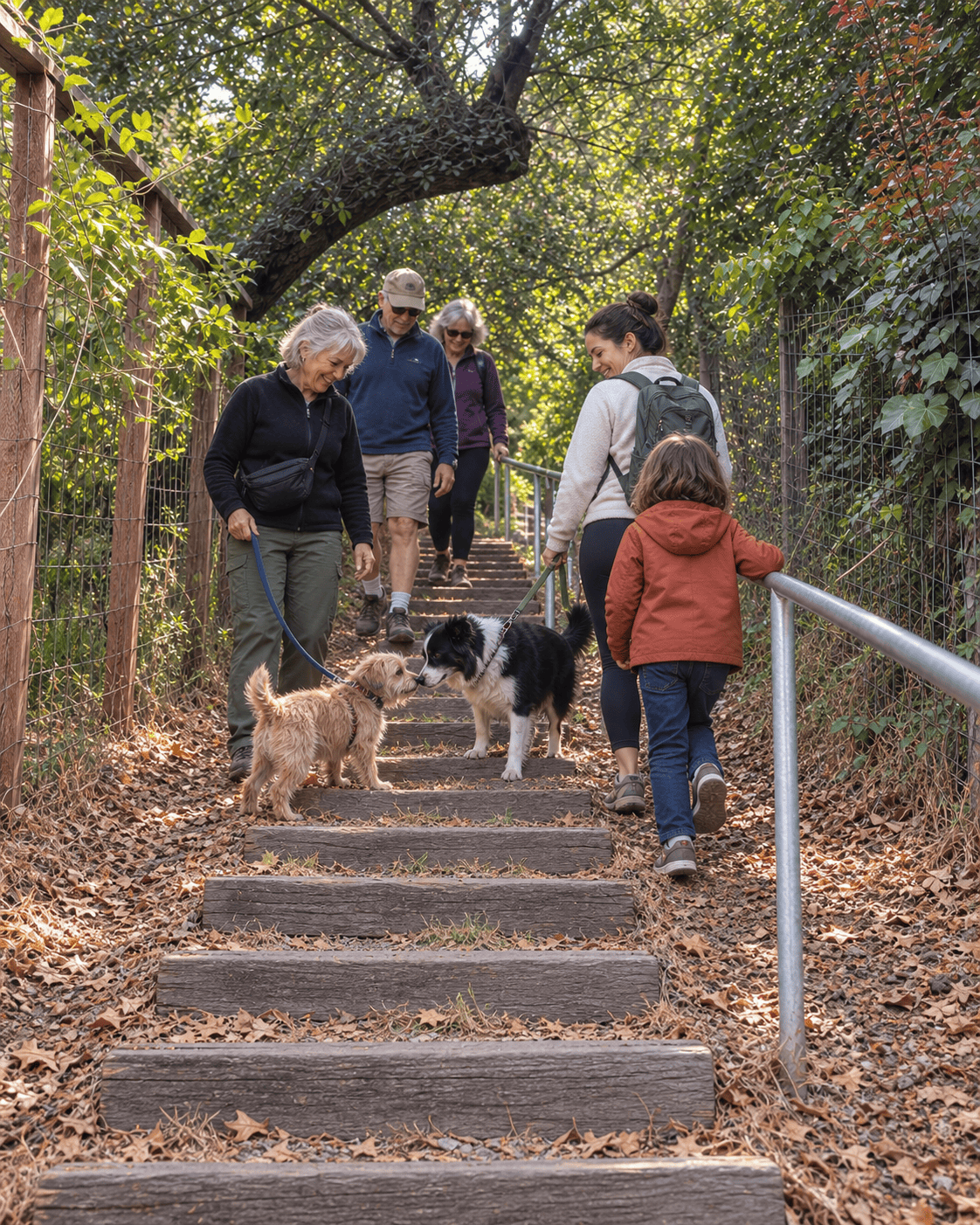
Where the hill staircases came from, and the four friends who saved them
Read the whole post: Where the hill staircases came from, and the four friends who saved themAround here, some of the best streets aren’t streets at all. They’re actually staircases.
When developers subdivided these hills in the early 1900s, a street grid didn’t work on a slope, so they ran roads along the contours instead. That’s why hill streets twist – and why the blocks are so long. Nobody had a car yet, so the developers cut pedestrian shortcuts through the blocks down to the streetcar lines. Those shortcuts are still public rights-of-way today. Plenty got overgrown, fenced off, or quietly absorbed into somebody’s yard.
In 1997 Ruth Armstrong pinned a notice at Berkeley’s North Branch library asking whether anyone wanted to do something about that. Jacque Ensign saw it and called. Two more friends joined, and the four of them started the Berkeley Path Wanderers Association – still all-volunteer, crews out Monday and Wednesday mornings replacing treads and adding handrails.
Inspired by them, El Cerrito Trail Trekkers formed in 2010 and started building here in 2012. Among the trails they’ve built and reopened is Motorcycle Hill, up from Navellier and Blake to the fire road on Potrero. Ninety-odd years ago that hillside hosted the National Motorcycle Hill Climb, and Sunday crowds gathered to watch riders try to make the top. The old photos show it bare and dusty, not a tree on it.
Between them the network runs from the Berkeley hills through Albany and El Cerrito. On foot the city line is invisible. So is the calendar – two weeks of walks, all free, nobody checking your address.
[Then the walk schedule for Sep 11 to 27: the Path Wanderers’ walks and booth, a 95th-birthday potluck for co-founder Jacque Ensign, and the Trail Trekkers’ Public Paths Festival, five walks.]
Every one of these is free, and every one is a great chance to see the stunning back side of your own neighborhood – the parts you can only reach on foot.
What’s the best set of steps near you that most people walk straight past?

Culture and history
A college town named for a poem
In 1866 trustees of the College of California chose the name Berkeley, after a poem by George Berkeley.
Harvest Festival at Cedar Rose Park
The City’s free annual fall celebration, in October.
October
See 3 more
306 City Landmarks, four historic districts
From the City’s landmark list, updated June 22, 2026.
Berkeley Historical Society and Museum
In the Veterans Memorial Building, 1931 Center Street, open Thursday to Saturday, 1 to 4.
The Berkeley Historical Plaque Project
Started in 1997, now a project of the Historical Society.
Community
Form a Firewise neighbourhood
Berkeley Fire supports groups of at least eight homes; 19 Firewise sites cover 1,336 homes.
Berkeley Architectural Heritage Association
The city’s non-profit preservation group, active since 1971.
See 3 more
Ecology Center and the farmers’ markets
Curbside recycling since 1973; markets since 1987, Tuesday, Thursday and Saturday.
Panoramic Hill Association
One of the neighbourhood groups the City meets on fire safety, in its 2023 account.
Solano Avenue Association
Runs the Solano Avenue Stroll, Albany and Berkeley’s shared festival.
City rules and regulations
Where roof water may go
Roof drains may not connect to your private sewer lateral; if the City finds one, it orders the fix.
Re-roof permit
A re-roof needs a building permit; the City says to assume you need one for any work not on its no-permit list, which has no roofing item.
See 4 more
Street trees are the City’s
The Urban Forestry Unit maintains them; the City will not prune to reduce leaf drop.
Coast live oak is protected
Removal and excessive pruning are restricted, on private and public land.
When you buy or sell Sewer lateral certificate
A private sewer lateral certificate is needed before close of escrow.
When you buy or sell Energy assessment at listing
One- and two-unit homes need an energy assessment when listed (BESO).
Need a hand with this? Roofing
Storms, flood and drainage
The rainy season: November to April
About 90 percent of the year’s rain falls then; December is the wettest month.
Free sandbags in storm season
From the City’s Corporation Yard, Monday to Friday 8 to 3, for residents and businesses with ID.
See 3 more
Report a clogged storm drain
Call 3-1-1 or (510) 981-6620.
Where the 100-year floodplain lies
Along the Bay edge, Aquatic Park, Codornices Creek and Strawberry Creek on campus.
Watch creek levels in real time
The City points to a gage map for Strawberry and Codornices Creeks.
Need a hand with this? Gutter cleaning
Programs, loans and insurance
Free metal mesh for vents and gutters
Residents in very high fire risk neighborhoods can apply for free metal mesh; materials only, not installation.
Updated Oct 7, 2026
Senior and disabled home rehab loans
Interest-free loans for owners 62 or older or with a permanent disability, under 80% of median income; roof repair is on the list. The City says its waitlist is open.
Updated Oct 7, 2026
See 5 more
City-paid defensible-space work
For residents 65 and over, with a physical limitation or on a low income, the City pays a licensed contractor directly.
Chipper Day: free curbside chipping
Any resident can reserve, mid-March to early December.
Home Hardening Tax Rebate
Up to one-third of the base 1.5% transfer tax, after a Class A roof and other hardening, for homes in the High or Very High Fire Hazard Severity Zones sold for less than $3,000,000 (the limit is adjusted each January). The work counts if done on or after Jan 1, 2025, from five years before the sale up to one year after.
Fence Replacement pilot
Up to 50% of approved costs, up to $2,500, for combustible fences in the first five feet.
Page 6/23/26
Insurance Insurers can ask for more than code
From Berkeley Fire’s insurance page.
Who serves your home in Berkeley
- Fire: Berkeley Fire Department
- Water: EBMUD
- Sewer: City mains and lower lateral; owners the upper lateral; EBMUD treatment
- Garbage: City Zero Waste Division
- Electricity: Ava Community Energy, delivered by PG&E
- Gas: PG&E
- Air: Bay Area Air District
- Storm drains: City Public Works; creeks on private land are the owner’s to maintain
- Assessor: Alameda County Assessor; appeals to the County Clerk
Useful links: Berkeley Unified School District · City of Berkeley parks · Berkeley Public Library (Tool Lending Library) · City 3-1-1 · Permit Service Center, 1947 Center St · AC Transit · BART · 211 Alameda County · AC Alert, Berkeley’s main emergency alerting system
The homes of Berkeley
Berkeley’s homes are old. The Census Bureau’s survey puts the median year built at 1944, and about 46 percent of homes date from 1939 or earlier; about four in five went up before 1980.
1850s-1900
Ocean View and remnant Victorians
West Berkeley, the old Ocean View; the Oceanview Sisterna Historic District holds houses such as the 1888 McVay House.
About 1900 to the 1940s
Bay Tradition and Arts and Crafts
Panoramic Hill and the La Loma district: mostly single-family houses clad in unpainted wood shingles, some stucco.
Mostly before 1970
The hill and north-side neighbourhoods
In the City’s 2023 account, more than 90% of homes in the Berkeley Hills, Live Oak, Thousand Oaks, Northbrae and Claremont/Elmwood tracts were built before 1970.
1940-1969
War years and the 1960s boom
The 1960s added about 6,500 homes; wartime brought the Codornices Village federal housing.
Roofs and gutters
What the sheet holds
In the City’s August 2025 hazards text, the flatlands are “densely covered with old wooden buildings, most not built to modern fire-resistant code.”
A City staff report of February 2025 says some homes in the Very High zone “still have wood shake roofs”.
Older roofs and gutters need a different hand: Gutter Repair · Roof Repair · Gutter Installation
The story of Berkeley
History and character
The Chochenyo-speaking Ohlone lived across the East Bay; the stretch from Richmond to Oakland was called Huchiun. At the mouth of Strawberry Creek, Indigenous people built the first of some 425 shellmounds that eventually surrounded the Bay.
In 1820 Luís María Peralta received Rancho San Antonio, bounded on the north by Cerrito Creek; in 1842 his son José Domingo got the part that takes in today’s Berkeley and Albany.
The settlement near the Bay was Ocean View. Bowen’s Inn of 1853 is a City landmark, and the 1855 starch and grist mill began West Berkeley’s life as an industrial district.
Trustees met on May 24, 1866 at the rock later called Founders’ Rock and named the town. The University was chartered in 1868 and its Berkeley campus opened in 1873.
From 1900 to 1930 new neighbourhoods grew along the Key System and Southern Pacific electric lines; the town hall of 1909 is today’s Old City Hall.
On September 17, 1923, in the Berkeley Historical Society’s words, “Wildfire destroyed nearly 600 homes and other buildings in North Berkeley and for a time threatened the whole city.”
Bernard Maybeck, John Galen Howard and Julia Morgan shaped the city; in the City’s 2002 account, the Arts and Crafts response gave Berkeley “a particular architectural distinction”.
New Deal agencies built the Rose Garden and the Berkeley Marina, and federal workers built Tilden Park. When the Bay Bridge opened in 1936 the ferry ended and the pier passed to the City.
In 1964, in the society’s words, “The Free Speech Movement exploded on the Cal campus.”
In 1961-62 three Berkeley women founded Save the Bay; Chez Panisse opened in 1971 on North Shattuck; in the 1990s the City built the Addison Street arts district around Berkeley Rep.
Berkeley, roof and gutters
Berkeley is two places for a roof and gutters. The land runs from the Bay shoreline up to the eastern ridgelines, where the City’s hazard plan puts the ground over 1,300 feet above the sea. Most of the city’s buildings went up between 1875 and 1940, according to the City’s General Plan, and nearly half of its homes were built before 1939, according to the Housing Element’s survey.
The rain comes in a season. About 24 inches a year at the two nearest federal weather stations. About 90 percent of it falls between November and April. The City’s own hazard plan names inlets clogged with leaf litter and debris as the most frequent cause of localized flooding in the streets.
Trees along the street are the City’s. Any tree on the City-maintained public right-of-way, in a median, in a park or on other City property is a City tree, looked after by the Urban Forestry Unit whoever planted it. The City does not prune or remove trees to minimize fruit, seed or leaf drop.
The coast live oak has its own protection. The City restricts removing it and pruning it excessively, on private land and public land alike.
In the hills, the City’s own rules reach roofs. Its wildfire page asks residents to keep trees taller than the roof pruned and to remove fallen debris from roofs and gutters. The City’s wildland-urban interface code, adopted in December 2025, puts it in writing: in the Very High zone, roofs and rain gutters must be kept clear of leaves, needles and other plant material, and across the City’s fire areas a roof that is replaced, or half replaced within a year, must be Class A.
If your roof or gutters have not had a look in a while, we would be glad to come by.
Landmarks and parks

Berkeley Rose Garden
A terraced amphitheater of 1,500 rose bushes, landmarked in 1937.

Indian Rock Park
Stone steps carved into the rock lead to a view across the Bay.

Old City Hall
Built 1908-1909 to designs by Bakewell and Brown.

Civic Center Park
Martin Luther King Jr. Civic Center Park, with the World Wall of community tiles.

First Church of Christ, Scientist
Bernard Maybeck’s 1910 church on Dwight Way.
Berkeley City Club
Julia Morgan’s 1929 building, a California Historical Landmark.

Piedmont Way
In the State’s words, “Olmsted’s first residential street design”, 1865.

Park at the Berkeley Waterfront
A former landfill with views of three bay bridges, and burrowing owls in winter.
How we can help in Berkeley
Why Sunshine Gutters and Roofing
- Family-owned since 2002, trusted by thousands of returning Bay Area homeowners
- Licensed (CSLB #1053780), bonded, with $2 million in general liability coverage
- Our own crew, never subcontractors
- We keep track of local regulations, fire safety rules and insurance programs
- We show you what we found, with photos, so you decide what happens next
Our work in and near Berkeley
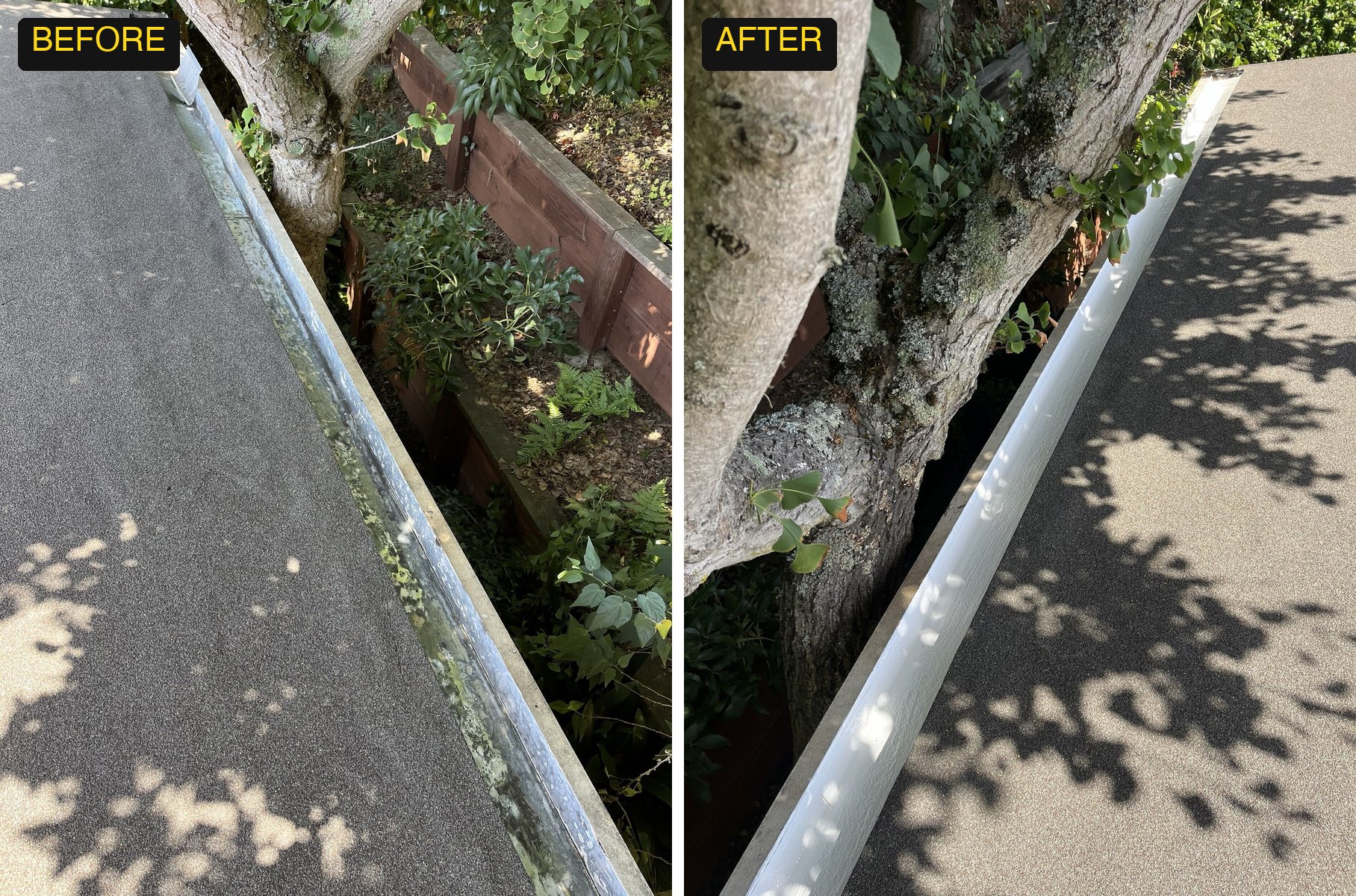
Gutter repair, Berkeley (our own job, before and after)

Gutter guards, Berkeley (our own job, before and after)
The year in Berkeley
| March | Defensible-space inspections begin; Chipper Day season opens |
|---|---|
| April | Rainy season ends |
| July | Tax appeals open Jul 2 |
| September | Tax appeals close Sep 15 |
| November | Rainy season begins |
| December | Wettest month |
Berkeley questions
What Berkeley homeowners ask us
Do I need a permit to replace my roof in Berkeley?
To replace it, yes. The City’s permit page says to assume you need a permit for any work that is not on its list of work that needs none, and that list has no roofing item. If you wish, we can also pull the permit for you, as most of our customers ask us to.
Does the Class A roof rule reach a re-roof in Berkeley’s fire areas?
Yes. Under the wildland-urban interface code the Council adopted on December 2, 2025, a roof covering in the City’s fire areas (the High and Very High zones and the two hill mitigation areas, not the flatlands) that is replaced entirely, or 50 percent or more within 12 months, must be a Class A assembly, and wood shakes and shingles are not allowed. If more than half of a roof is replaced within any five years, the whole roof must be brought to that standard.
Do I need a permit to remove a tree in Berkeley?
Only for a coast live oak. The City restricts removing a coast live oak above set trunk sizes, and exceptions must be approved by the City Manager or their designee. For other trees on private property, the City’s 311 answers say no permit is required.
What do I do with the brush and limbs I cut?
The City’s Chipper Day chips and picks up vegetation debris from homes for free, by reservation for each event. Its list of what goes in the pile includes shrubs, brush, tree limbs, wood and bushes. Leaves are not on that list, and small amounts of plant material can go in the green bin.
What our customers say








Get a free estimate
We usually respond promptly within the day. Phone first for emergencies: (510) 525-0880.
Where we work
Berkeley neighbourhoods we serve


North Berkeley
The early 1900s “Berkeley Bohemia” lived in the part that came to be known as Nut Hill.
Northbrae
Indian Rock, Great Stoneface and Cragmont: the City’s “rock parks in the Northbrae area”.
Thousand Oaks
The Solano Avenue area runs through Thousand Oaks and Northbrae.
Cragmont
Cragmont Rock Park “rises out of the Berkeley Hills with dramatic outcrops”.
Live Oak
Live Oak Park is “the site of several community festivals”.
Elmwood
College Avenue is “the main commercial corridor of the Elmwood neighborhood”.
Westbrae
West Berkeley
The 1855 mill began its “heritage as an industrial district”.
South Berkeley
San Pablo Park is, in the City’s words, “South Berkeley’s largest community park”.
Downtown Berkeley
The 1876 Shattuck Avenue railroad helped build it; the Civic Center Historic District dates from 1998.
Northside
Lorin
“South Berkeley’s historic Lorin District on Adeline Street”, home of the Juneteenth Festival.
Also serving nearby: Oakland · Albany · Emeryville · Kensington