

Gutters and Roofs for Gilroy, a Community with a Spice for Life
Gutter and roof installation, cleaning, repairs and rejuvenation. Family-owned since 2002, trusted by thousands of returning Bay Area homeowners.
Gilroy, in short
Which trees in Gilroy need a permit to remove?
A permit is needed to remove a protected native tree, such as an oak, California bay, madrone or alder, with a single trunk 38 inches around at four and a half feet up, or a heritage tree of any species at 90 inches around. Gilroy states both in circumference; 38 inches is about 12 across, by our own arithmetic.
The story of Gilroy
Gilroy, named for John Gilroy and a city since 1870, by the City’s account.
The town is named for John Gilroy, “the proprietor of this portion of Rancho San Ysidro”, the City’s 2020 study says. The City’s history page says it began in 1850 as a stage and postal station along Monterey Street, part of the original El Camino Real, and that “In March 1870, an act of the state legislature incorporated Gilroy as a full-fledged city.” Tree crops dominated farming around Gilroy until the early 1960s, when orchards gave way to row crops, “of course, garlic”.
The City says, “The earliest Spanish land grants in the Gilroy area were the Las Animas (covering much of present-day Gilroy) and the San Ysidro (east of town) grants.”
The City’s 2020 study says John Gilroy became a naturalized Mexican citizen in 1833, and its history page says he “served as alcalde (mayor) of San Ysidro, and in 1846 was appointed Juez de Paz (Justice of the Peace) for the district.”
The City’s history page says the village began in 1850 as “a stage and postal station along Monterey St.”
In the late 1850s, the City says, Henry Miller “purchased much of the enormous Las Animas Rancho, eventually owning over 12,000 acres in the Gilroy area”, and his summer ranch atop Mt. Madonna “is now a Santa Clara County Park.”
The 2020 study says Italians “are credited with introducing the propagation of tomatoes, onions and garlic to the area”.
A rail line connecting the community was completed in 1869, the City says, “making this community a hub of the southern Santa Clara Valley.”
The City says John Gilroy died in July 1869 and “is buried in the Old St. Mary Cemetery.”
The City’s history page says, “In March 1870, an act of the state legislature incorporated Gilroy as a full-fledged city.”
The 2020 study says Japanese families began settling in the area as early as 1902 and “found considerable success in growing row crops like strawberries and garlic.”
The City says that in 1906 “a large crowd celebrated the opening of Gilroy’s new City Hall at Sixth and Monterey Streets”, while the Historical Society dates the building 1905. The clock on its tower, the City says, was a gift of local philanthropist Caroline Hoxett.
The 2020 study says Linwood Wheeler bought the A.J. Pieters Seed Company in 1910 and moved it to Gilroy the same year, and that the Wheeler family “donated generously to civic projects in Gilroy”, among them the Wheeler Hospital.
The Gilroy Public Library opened in the Carnegie Library Building on July 27, 1910, the City says; the building was designed by architect William Weeks, on a lot that Caroline Hoxett gave the City.
The Historical Society says Gilroy’s first fire station, from 1916, “served the City until 1978 when a modern fire station was built and this building was converted to a restaurant.”
The Historical Society says the Southern Pacific Railroad built the current depot in 1918 “as a replacement for Gilroy’s first railroad station opened in 1869”, after “the State Railroad Commission ordered Southern Pacific to build this handsome replacement.”
The Society says the Milias Hotel, built in 1922, “was the first three-story building in Gilroy”, and its elevator, “the first in the city”, “was quite the novelty in the community at the time”.
The 2020 study records the testimonial “dedicated to Henry Hecker whose foresight made possible the completion of the Yosemite to the Sea Highway”, dated May 27, 1928.
On Arbor Day 1930, the study says, the Gilroy Rotary planted a row of 75 Deodar cedar trees along Hecker Pass, a row that “persists to present day along this stretch of highway”. The General Plan has a policy for the “heritage cedar trees located on the south side of Hecker Pass Highway”.
The study says Gilroy Foods incorporated in 1958 as a processing plant “specializing in dehydrated garlic” and by the end of the 1980s “was processing and/or packing approximately 90 percent of the world’s garlic for the wholesale and mainstream consumer markets.”
In 1963, the City says, it formally established the Gilroy Museum in the basement of the Carnegie Library Building, and the library “remained there until 1975, when it moved to its current location at 6th and Rosanna streets.”
The Historical Society says it “was formed in 1966” when Old City Hall “was threatened with destruction.”
The Historical Society says the depot closed in 1972, and the study says it “gained new life as a multi-modal transportation station for local and intra-city bus service in 1986, and train service was restored in 1992.”
The 2020 study says that in the summer of 1978 “three local Gilroyans hosted a modest luncheon event that featured garlic as the star attraction”, and that the first Garlic Festival was “held at the Bloomfield Ranch on August 4-5, 1979”, where “Over 15,000 people attended in the first year alone”.
The study says that in the 1980s “the State of California imposed a sewer hookup moratorium for the City of Gilroy, which effectively halted the pace of growth in the city to a crawl”.
The park’s page says an effort called the 80-Ton Tree Caper began in 1985 “to carefully dig up the surviving trees, transport them over the Santa Cruz Mountains, and transplant them at what is now Gilroy Gardens Family Theme Park.”
The park’s page says Bonfante Gardens “officially opened to the public on June 15, 2001”.
The City’s 2020 study says the City “purchased the park and the 536 acres it sits on in 2006 and changed the name to Gilroy Gardens in 2007”.
Fire safety
The State’s map and Gilroy
The State published its 2025 fire hazard maps for local areas in four phases between February 10 and March 24, 2025. Read from that map, Gilroy has High and Moderate zones inside the city and no Very High zone. By our count on a grid of sample points over the city, about 21 percent of it is in the High class and about 17 percent in the Moderate class, and about 62 percent is non-wildland land. As we read the City’s map picture, the zones lie on the western and south-western hills.
State layer read Oct 26 2026; the City’s map picture looked at Oct 26 2026
The City adopted the State’s map
The City adopted the State’s map by Ordinance 2025-05, passed on June 16, 2025, which says the City “hereby designates the Fire Hazard Severity Zones as recommended by the State Fire Marshal pursuant to Section 51178 of the Government Code.” The City Code carries it as section 10.17, “Adoption of Fire Hazard Severity Zones Map.”
Ordinance passed June 16, 2025; City Code read in Chrome Oct 26 2026
See 6 more
The City’s fire and wildland code
Ordinance 2025-07, passed on August 18, 2025, adopts the 2025 California Fire Code and the 2025 California Wildland-Urban Interface Code, and the City Code calls the result the “Gilroy Fire and Wildland-Urban Interface (WUI) Code”. The ordinance applies the interface code to buildings in the city’s Residential Hillside (RH) zoning district and in the Moderate and High fire hazard severity zones, and adopts it “consistent with the State’s adoption, with no amendments.”
Ordinance passed August 18, 2025; City Code read in Chrome Oct 26 2026
The Fire Prevention Program
The City’s Fire Prevention Program page says its work includes “fire plan check reviews for construction and operational permits and inspections, annual State-mandated inspections, weed abatement, and Fire Prevention Code Enforcement.”
City page undated, read Oct 26 2026
Weeds
The City’s Fire Prevention page says, “The Weed Abatement program is a Santa Clara County program.” The County’s page says, “All areas of the county are required to maintain the standards until October 31, every year.”, and its list gives Gilroy its own inspection date, May 15. The City Code makes it the owner’s duty not to “permit weeds or refuse to remain or accumulate upon such premises”.
City page undated; County page prints no year on its date list; City Code read in Chrome Oct 26 2026
Defensible space and home hardening
The City’s wildfire page says residents in wildland-urban interface areas “should prepare for wildfires by maintaining adequate defensible space on your property and by hardening your home.” The City’s home hardening page asks owners to “Keep roofs/gutters clean”. CAL FIRE’s page tells homeowners, “Remove all dead and dying plants, weeds, and debris (leaves, needles, etc.) from your roof, gutter, deck, porch, stairways, and under any areas of your home.” It is CAL FIRE’s guidance for homeowners across the state.
City pages undated, read Oct 26 2026; CAL FIRE page undated, read Oct 20 2026
Mowing and equipment on hot, windy days
The City’s wildfire page says, “Never mow or trim dry grass on a Red Flag Warning Day.” It adds that “Spark arresters are required in wildland areas on all portable gasoline-powered equipment.”
City page undated, read Oct 26 2026
Fireworks
The City’s page says, “State-approved fireworks may be purchased and used only in Gilroy and only from July 1 – July 4 (midnight).”
City page undated, read Oct 26 2026
Need a hand with this? Gutter guards
-
From the Gilroy blog
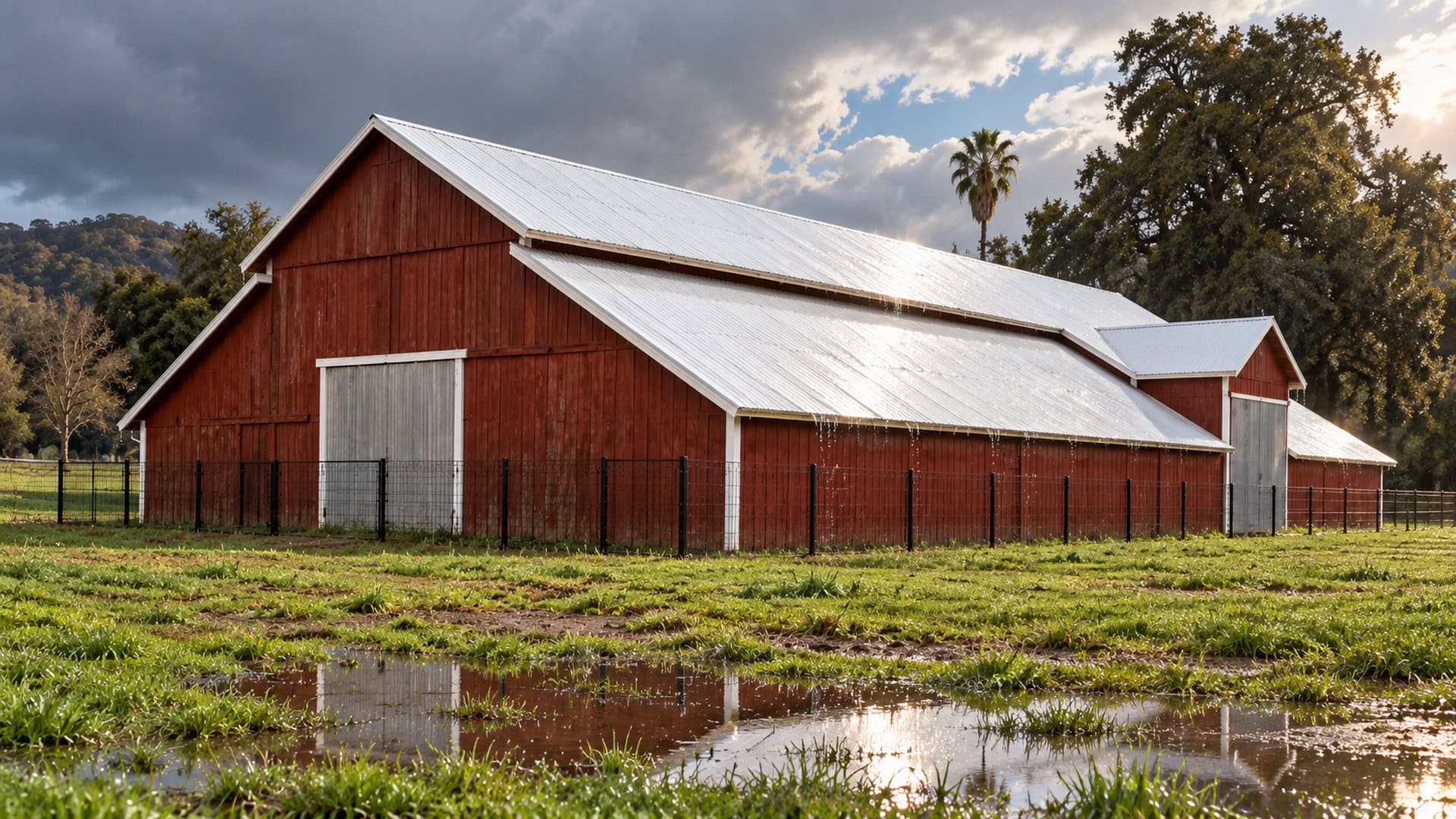
The barn Gilroy almost tore down
Read the whole post: The barn Gilroy almost tore downOn the north side of Christmas Hill Park stands a big red barn that came within months of being torn down.
Cattle baron Henry Miller built it in 1891, a redwood hay barn for his cattle and horses, later used for processing fruit. The City got the park land in 1962 and bought the barn’s parcel in 1990. For a while the barn stored Garlic Festival signs. Then the City worried about the structure and closed it, and by the mid-1990s it was sealed shut.
In November 2013 the City Council voted to take it down. That December the president of the Gilroy Historical Society said the roof was “half torn off.”
Neighbors asked for one year to save it. In February 2014 the Council gave them that year to come back with money and a plan. They went looking and found the proof: a San Jose newspaper item from May 1891 reporting that Miller was building the barn. An engineering firm found “nothing fundamentally wrong in the structure.” In 2016 the demolition plan officially ended, and the barn went on the National Register of Historic Places.
The first big job was the roof. Years of wind and rain had curled its 1950s metal sheets until the fastenings failed and holes opened. The volunteers replaced it in 2017. In 2020 the barn went onto a new concrete foundation, with one side lifted 12 inches to level it. In 2021 came the paint: a blue-grey primer first (“Some people thought that the Red Barn had changed into the Blue Barn”), then red with white trim.
That’s the order on any old building: roof first. It’s true to any house; longevity depends a lot on a clear and functioning roof and gutter systems. Before the rains, check that the roof edges are tight and the gutters and downspouts are clear. If you ever need a professional eye and hands on your roof and gutters, we’ll be honored to be at your service. Sunshine Gutters and Roofing – Let us shine on your rainy day.

Culture and history
Gilroy Museum
The City’s museum page says its collection “consists of over 25,000 items relating to the history of Gilroy and the South Santa Clara County area.” It says, “Tours are given on the 1st Saturday of each month from 10 a.m. to 12 noon.”
City page undated, read Oct 26 2026 (refresh before use)
Walking tours with the Historical Society
The Historical Society’s 2026 schedule lists a free tour on the first Saturday of the month (“Tours Free”), on subjects such as “MONTEREY STREET”, “BUNGALOWS” and “WILLIAM WEEKS BUILDINGS”, and shows no tour in July, September and December.
Society’s 2026 schedule (a PDF), read Oct 26 2026; the tours are monthly
See 9 more
Downtown plaques
The Historical Society’s downtown plaques page names 33 buildings and houses, with their years as printed, among them the Carnegie Free Library (1910), Old City Hall (1905), the Strand Theater (1921) and the Southern Pacific Railroad Depot (1918).
Society’s page undated, read Oct 26 2026
The Garlic Festival
The festival’s own site says the 2027 Gilroy Garlic Festival “will be held on Friday, Saturday and Sunday, July 23, 24 & 25, 2027.” It will be held at the Hecker Pass Outdoor Events Center, which the festival’s FAQ page calls “a separately gated special event space adjacent to Gilroy Gardens.” The festival’s page says it is “hosted by hundreds of community volunteers”.
Festival’s pages read Oct 26 2026 (the home page title still shows July 2026; the body and the FAQ give 2027)
What the City calls itself
The City’s About page calls Gilroy the “Garlic Capital of the World,” and its tagline is “A Community with a Spice for Life.”
City page undated, read Oct 26 2026
The Gilroy Rodeo
The Gilroy Rodeo’s own site shows “August 13-15, 2027”. Its history page says the rodeo “returned to the scene in 2018”, after it “ceased in 1956.”
Rodeo’s site read Oct 26 2026
Gilroy Gardens’ Circus Trees
Gilroy Gardens Family Theme Park says its Circus Trees are “a collection of sycamores, box elders, ash and Spanish cork trees that were originally shaped and grafted into whimsical shapes starting in the 1920s” by Axel Erlandson. The park says it has “more than 10,000 trees still growing throughout the park’s 26+ acres.”
Park’s page read Oct 26 2026
Who runs Gilroy Gardens
The park’s page says it is a “501(c)(3) nonprofit corporation” and that “A Board of Directors guides the decision making for the development, maintenance, and operation of our unique park.” It adds that the park is “an independent entity operating in collaboration with the City of Gilroy.”
Park’s page read Oct 26 2026
Mt. Madonna, Coyote Lake and Henry W. Coe
The City’s About page points to “many hiking and biking trails at nearby Mt. Madonna, Coyote Lake, and Henry W. Coe parks”.
City page undated, read Oct 26 2026
A name from the ranchos
Gilroy is named for John Gilroy, “the proprietor of this portion of Rancho San Ysidro”. More in The story of Gilroy, below.
Orchards, row crops and garlic
The City says tree crops dominated farming around Gilroy until the early 1960s, when orchards gave way to row crops, “of course, garlic”. More in The story of Gilroy, below.
Community
Gilroy Historical Society
The Society’s mission is “to inform our community about Gilroy’s unique heritage by collecting and preserving Gilroy’s artifacts”. It says it is incorporated as a “501(c)(3) educational organization”.
Society’s page undated, read Oct 26 2026
Arts and Culture Commission
The City’s Arts and Culture Commission is “a 7-member body which is responsible for advising the Recreation Department and the City Council on all matters pertaining to cultural and artistic activities”.
City page undated, read Oct 26 2026
City rules and regulations
Re-roofs
A re-roof takes a permit and inspections. The Building Division lists “Re-roofing” among its examples of projects that need a permit. The City’s re-roof handout says, “If you are going to have a contractor perform the work, the contractor shall obtain the permit.” If you pull the permit yourself, it says, “you are the party responsible for ensuring the work meets all code requirements.”
City page undated; handout revised 03/23/2026; read Oct 26 2026
Overlays and the final inspection
The handout says, “Roof overlays require a permit. Overlays are allowed over one (1) existing layer, and a pre-roof inspection is required prior to covering roof.” The final inspection comes “Once new roof installation is complete and smoke/CO alarms are installed.”
Handout revised 03/23/2026, read Oct 26 2026
See 10 more
Weight limit
If the new roof “will exceed a total weight of 7.5 lbs/square foot (including sheathing and roofing material), additional roof framing and support information will be required as well as review by the City’s structural engineer.”
Handout revised 03/23/2026, read Oct 26 2026
Flashing at gutters
The handout says to “Provide roof flashing at all wall and roof intersections, parapet walls, gutters, and where there is a change in the roof slope or direction around roof openings.” It adds that the flashing is “a minimum 26 gauge galvanized metal.”
Handout revised 03/23/2026, read Oct 26 2026
A home with solar panels
The City’s solar policy says, “A re-roofing permit can only be issued to a licensed C-39 roofing contractor, a licensed ‘B’ contractor, or issued to an ‘owner-builder’, as allowed by state law.” It adds, “A C-39 roofing contractor cannot remove and re-install the solar PV system.”
Policy revised 03/14/2025, read Oct 26 2026
The 2025 building codes
The Building Division lists the “Adoption of the 2025 California Building Codes with local amendments- See Ordinance 2025-06.” Ordinance 2025-06 was passed on August 18, 2025. For permits filed on or after January 1, 2026, the City’s home hardening page says to “design to 2025 California WUI Code (Title 24, Part 7) and the 2025 CBC/CRC, as adopted by the City.”
City pages and ordinance read Oct 26 2026
Roof drains, gutters and downspouts
The City’s property maintenance rule, in Ordinance 2025-06, says, “Roof drains, gutters and downspouts shall be maintained in good repair and free from obstructions.” It adds, “Roof water shall not be discharged in a manner that creates a public nuisance.”
Ordinance passed August 18, 2025
Connecting to the storm system
The City’s storm water page says, “Always obtain a permit before modifying a storm or waste water piping system, and never make a connection into the municipal system without a permit.”
City page undated, read Oct 26 2026
Which trees are protected
The City’s Tree Removal Permits page defines a protected tree as “Any indigenous tree native to the Gilroy region, including all species of Oaks, California Bay, Big Leaf Maple, Madrone, California Sycamore, California Buckeye, and Alder”, with a single trunk of 38 inches in circumference or more at four and a half feet above the grade. A heritage tree is “A tree of any species with a single trunk of 90 inches in circumference or more at a point four and one half feet (4 1/2) above the grade.” Nonindigenous tree species and orchards, “including individual fruit and nut trees”, “are exempt from this definition for the purpose of this section.”
City page undated, read Oct 26 2026
Applying to remove a tree
The ordinance “aims to protect indigenous and heritage trees and preserve the many benefits that these trees bring to our town by requiring a person who wishes to cut down such a tree, located on private property, to go through a permit process.” The application needs an arborist report, and the arborist must be “Certified by the International Society of Arboriculture (ISA)”. The permit has a fee, set in the City’s Comprehensive Fee Schedule. The City’s page says, “In order to approve an application for tree removal, the following findings must be made:”, the first being that “The tree is dead, diseased or in danger of falling”.
City page undated, read Oct 26 2026
Street trees
The City’s FAQ says a street tree is “any tree planted by or on behalf of the city in the street right-of-way”, typically in the “park strip” between the sidewalk and the street. As the adjacent owner, it says, “residents SHALL NOT trim, prune, spray, or remove city trees without a permit from the city.” It adds, “Maintenance includes watering, and removing fallen leaves, branches, and fruit debris.”
City FAQ undated, read Oct 26 2026
Trees on private property
The City’s FAQ says, “We can’t perform tree work on private property, so you would need to hire an arborist.”
City FAQ undated, read Oct 26 2026
Need a hand with this? Roofing
Storms, flood and drainage
Check back Sandbags
The City of Gilroy keeps a “fill it yourself” sandbag station next to the city corporation yard on Old Gilroy Street. The City says, “Sand and empty bags are provided: however, you must bring a shovel.” The City’s page gives no dates or hours, so check back. Valley Water’s page says, “Sandbag sites and sandbags are only available from November 1 through April 15 of each year.” Valley Water’s own sites are in Alviso, Morgan Hill, Palo Alto and San Jose, and its page says, “There are additional sandbag sites managed by various cities within Santa Clara County.” It adds, “some sites require proof of residency.”
City page undated; Valley Water page undated; both read Oct 26 2026
How flooding starts here
The City’s flood page says, “Gilroy has multiple watershed drainage canals and creeks.” It adds, “This can create problems when we receive substantial rainfall, reservoirs are at capacity, and the soil is saturated.”, and that “Flooding can develop quickly or over a period of days with these conditions”.
City page undated, read Oct 26 2026
See 4 more
The creeks
A draft environmental report of June 22, 2020 says two sub-watersheds cross the city, the Uvas Creek Watershed and the Llagas Creek Watershed, and that the city “generally is bound to the southwest by Uvas Creek and to the east by Llagas Creek.” Both drain to the Pajaro River and Monterey Bay.
Draft dated June 22, 2020, read Oct 26 2026
How much of the city is in a flood hazard area
The General Plan says, “Most of Gilroy is not within a 100-year floodplain”. By our count on a grid of sample points over FEMA’s flood map, about 17 percent of the city’s area is in a Special Flood Hazard Area.
General Plan adopted November 2, 2020; FEMA layer read Oct 26 2026
Check the flood map for your address
The City’s flood page links the “Real-Time Stream Level Alert System”, the FEMA Flood Hazard Map and “The Uvas Creek Overflow Floodplain Management Study”.
City page undated, read Oct 26 2026
The rain the plumbing code designs for
The City’s permit FAQ handout lists “Maximum Rainfall: 1.5 inches per hour.” with the note “(Table D-1, CPC)”. That is a design figure of the plumbing code, not a yearly or storm total.
Handout revised 12/17/2024, read Oct 26 2026
Need a hand with this? Gutter cleaning
Programs, loans and insurance
No-cost home repairs: Rebuilding Together Silicon Valley with the City
The City’s Home Modification page says, “Apply for NO-COST HOME REPAIRS by Rebuilding Together Silicon Valley, a non-profit organization servicing Santa Clara County.” It says, “Applicants must be low-income homeowners who reside in the incorporated area of Gilroy.” The work ranges “from small safety modifications, like grab bars, low-rise steps, and handrails, to larger structural changes, like siding, skirting, exterior/interior painting, and more!”; the page does not name roofs or gutters. Rebuilding Together’s own page says to qualify you must own a home within its service area as your primary residence, with a household income below 80% AMI, and that its list of places served names Gilroy. It says, “Applications are accepted year-round, however that does not guarantee acceptance.” and “Resources are limited, and applications will be reviewed on a first come, first served basis.” To have an application mailed, the City’s page says to contact Rebuilding Together at (408) 578-9519.
City page undated, read Oct 26 2026; Rebuilding Together’s page read Oct 26 2026
County-wide Valley Water rebates
The City’s rebates page lists the “Valley Water Landscape Rebate Program” among Gilroy’s rebates. Valley Water’s Rainwater Capture Rebate is for a home with “an existing gutter or downspout system not currently capturing rainwater”: “Valley Water will help you install rain barrels, cisterns, and rain gardens.” Its page says, “Current program funding lasts until June 30, 2027, or until depleted.” As we read it, Valley Water’s page names no town. Residents and business owners in Santa Clara County are eligible. Valley Water’s page says applications are accepted “in the order received as long as funds remain available.” The steps to qualify are on Valley Water’s online application portal; the rebate amounts, how many times you can use it and how long the benefit lasts are not on the pages we read, and whether funds remain today is not known.
City page undated, read Oct 26 2026; Valley Water pages (undated) as read for the county sheet of Oct 14 2026
See 6 more
County-wide Check back Roof repairs: Habitat for Humanity East Bay/Silicon Valley
Habitat’s Home Repair page says, “Services are currently available in select cities in Alameda, Contra Costa, and Santa Clara counties.”, and its list of cities includes Gilroy. Its critical repairs include “roof repairs”. Its page says the Home Repair Program “preserves homeownership for low-income residents”, and “All home repairs are performed by licensed contractors and overseen by our skilled construction staff.” You start with a Request for Service form. Habitat’s page does not say whether applications are open now, and the pages we read give no income limit or cost.
Habitat’s page read Oct 26 2026 and as read for the county sheet of Oct 14 2026
County-wide Energy rebates and weatherization: Silicon Valley Clean Energy, BayREN, PG&E
The City’s rebates page lists “Silicon Valley Clean Energy Incentives”, “PG&E Rebates and Incentives” and “BayRen Residential Rebates”. Silicon Valley Clean Energy names Gilroy among the communities it serves as the official electricity provider; the pages we read give no rebate terms for it. BayREN’s EASE Home program, which lists Santa Clara County, is for households that “Are a PG&E customer,” “Have a household income under or at 120% AMI,” and “Live in a single-family home (four or fewer units) built before 2010.” It says, “BayREN covers 80% of the cost for essential weatherization upgrades, including insulation and duct sealing,” with your portion “capped at 20% of the project cost,” and “Households can only benefit once from CPUC incentives for the same improvement, product, equipment or service.” PG&E’s Energy Savings Assistance Program offers to “Improve the energy efficiency of your home at no cost to you” in a house, mobile home or apartment “at least five years old”, with furnace and water heater repair or replacement for eligible homeowners “if PG&E determines that existing natural gas units are inoperable or unsafe.” Neither program’s page says whether it is open now, and PG&E’s page names no county, so it is not known whether a given Gilroy home qualifies.
City page undated, read Oct 26 2026; program pages (undated) as read for the county sheet of Oct 14 2026
State-wide LIHEAP and the Weatherization Assistance Program
LIHEAP, the federal Low Income Home Energy Assistance Program, is run in California by the Department of Community Services and Development through local service providers, and the household applies to the local provider. The Department’s page says, “Eligibility for LIHEAP services can vary depending on income, household size, place of residence, and other factors.” It describes one-time help with a utility bill, help in an energy crisis and free weatherization upgrades. The Department also works with local providers on the federal Weatherization Assistance Program for low-income homeowners and renters, and says, “Use the Find Services in Your Area function to locate the agency in your area, then contact them to apply for assistance.” Its toll-free help line is (866) 675-6623. The pages do not say whether LIHEAP is open or closed, and no page we read names the provider for Gilroy.
Pages read Oct 20 2026
State-wide Check back Earthquake Brace + Bolt: check back
Earthquake Brace + Bolt is a program of the California Residential Mitigation Program, a joint body. Its page says, “An EBB seismic retrofit is only done on wood-framed, pre-1980 homes with a raised foundation.” It says, “EBB program registration is open for a limited time each year.” When the registration page was read on Oct 20 2026 it said, “The EBB Program is currently closed.” The county sheet read the program’s 2025 Northern California ZIP list as naming Gilroy, ZIP 95020; the program’s ZIP page is a search form, and the search for 95020 has not been run.
Program pages read Oct 20 2026
State-wide Check back California Safe Homes: check back
California Safe Homes, the State’s grant program for roof replacement and the first five feet around the home, is not open.
Standing check of Oct 8 2026
Insurance The City’s fire protection class
The City’s page links its 2026 ISO report on its fire suppression (ISO’s Public Protection Classification), created in January 2026 and effective May 1, 2026. The report says, “ISO concluded its review of the fire suppression features being provided for Gilroy. The resulting community classification is Class 02/2Y.”
Report created January 2026, effective May 1, 2026; read Oct 26 2026
Who serves your home in Gilroy
- Fire: The City’s own Gilroy Fire Department, a City department with its own Fire Chief. The City lists four stations: Chestnut, which is the department’s headquarters, Las Animas, Sunrise and Santa Teresa Interim.
- Water: The City’s Water Section, part of its Utilities Operation Division, which is “responsible for planning and maintaining city wells, booster pumps and reservoirs, and the distribution system that provides safe drinking water to the city.”
- Sewer: The City’s Wastewater Collection Division maintains “the City’s sanitary sewer collection infrastructure”, and the flow continues to the plant of the South County Regional Wastewater Authority. The City describes the Authority as “a joint powers authority established to manage the treatment of wastewater for the Cities of Gilroy and Morgan Hill.”
- Garbage and recycling: The City “contracts with Recology South Valley for solid waste, recycling, and street sweeping services.”
- Electricity: Silicon Valley Clean Energy, which names Gilroy among the communities it serves as “the official electricity provider”.
- Schools: The City’s Housing Element says, “The entirety of Gilroy is served by the Gilroy Unified School District.”
- Streets, trees and storm drains: The City’s Streets, Trees and Storm Water Maintenance staff are responsible for “public storm drains throughout the city” and “24-hour emergency tree response”. The General Plan says the City “owns and operates the major storm drainage facilities that serve the City”: about 96 miles of pipelines, a single retention basin and about 150 outfalls to canals and creeks. That is the street’s drainage system, not roof gutters.
- Valley Water: Valley Water, the county’s water district: the City’s flood page links “Valley Water Flood Protection Resources”, and its water page says, “Valley Water offers a variety of rebates to encourage water conservation.”
Useful links: Gilroy Unified School District · City of Gilroy: Fire Department · City of Gilroy: Fire Hazard Severity Zone Maps · City of Gilroy: Building Division (permits and re-roofs) · City of Gilroy: Tree Removal Permits · City of Gilroy: Flood Management and sandbags · City of Gilroy: Home Modification (Rebuilding Together) · Santa Clara County Weed Abatement Program · Valley Water (sandbags) · Recology South Valley · Silicon Valley Clean Energy · Gilroy Museum · Gilroy Historical Society · Gilroy Garlic Festival · Gilroy Rodeo · Gilroy Gardens
The homes of Gilroy
Gilroy’s median home was built in 1989, by the Census Bureau’s 2020-2024 survey. The State counted 19,450 housing units in January 2026, about 68 percent of them single detached houses and about 2 percent mobile homes, our own calculations from its count. About 20 percent of the homes were built before 1970 and about 65 percent in 1980 or later, our own calculations from the survey’s table. The City’s Housing Element puts owner-occupied homes at 61.5 percent in 2019, from an older survey release.
1857 to 1912
Houses on the Society’s plaque list
The Historical Society’s downtown plaque list names the Willey House (1857), the Amos Robinson House (1882), the Weaver-Tremaine House (1900), the Holloway House (1903) and the Jessen-Menke House (1912/1913).
1840 to 1910
Italianate, Stick/Eastlake and Queen Anne
The City’s 2020 historic study lists Italianate (1840-1885), Stick/Eastlake (1860-1895) and Queen Anne (1880-1910) among the residential styles found in Gilroy.
1905 to 1940
Craftsman and Spanish Colonial Revival
The study lists Craftsman (1905-1930) and Spanish Colonial Revival (1915-1940).
1933 to 1975
Mid-Century Modern, Ranch and Minimal Traditional
The study lists Mid-Century Modern (1933-1965), Ranch (c. 1935-1975) and Minimal Traditional (c. 1935-1950).
Planned since 2020
New neighborhoods at the edges
The 2040 General Plan says the Hecker Pass plan “includes plans for 521 dwelling units”, and the Glen Loma Ranch plan “calls for up to 17 residential neighborhoods with a maximum of 1,693 dwelling units”.
Older roofs and gutters need a different hand: Gutter Repair · Roof Repair · Gutter Installation
The story of Gilroy
History and character
The City says, “The earliest Spanish land grants in the Gilroy area were the Las Animas (covering much of present-day Gilroy) and the San Ysidro (east of town) grants.”
The City’s 2020 study says John Gilroy became a naturalized Mexican citizen in 1833, and its history page says he “served as alcalde (mayor) of San Ysidro, and in 1846 was appointed Juez de Paz (Justice of the Peace) for the district.”
The City’s history page says the village began in 1850 as “a stage and postal station along Monterey St.”
In the late 1850s, the City says, Henry Miller “purchased much of the enormous Las Animas Rancho, eventually owning over 12,000 acres in the Gilroy area”, and his summer ranch atop Mt. Madonna “is now a Santa Clara County Park.”
The 2020 study says Italians “are credited with introducing the propagation of tomatoes, onions and garlic to the area”.
A rail line connecting the community was completed in 1869, the City says, “making this community a hub of the southern Santa Clara Valley.”
The City says John Gilroy died in July 1869 and “is buried in the Old St. Mary Cemetery.”
The City’s history page says, “In March 1870, an act of the state legislature incorporated Gilroy as a full-fledged city.”
The 2020 study says Japanese families began settling in the area as early as 1902 and “found considerable success in growing row crops like strawberries and garlic.”
The City says that in 1906 “a large crowd celebrated the opening of Gilroy’s new City Hall at Sixth and Monterey Streets”, while the Historical Society dates the building 1905. The clock on its tower, the City says, was a gift of local philanthropist Caroline Hoxett.
The 2020 study says Linwood Wheeler bought the A.J. Pieters Seed Company in 1910 and moved it to Gilroy the same year, and that the Wheeler family “donated generously to civic projects in Gilroy”, among them the Wheeler Hospital.
The Gilroy Public Library opened in the Carnegie Library Building on July 27, 1910, the City says; the building was designed by architect William Weeks, on a lot that Caroline Hoxett gave the City.
The Historical Society says Gilroy’s first fire station, from 1916, “served the City until 1978 when a modern fire station was built and this building was converted to a restaurant.”
The Historical Society says the Southern Pacific Railroad built the current depot in 1918 “as a replacement for Gilroy’s first railroad station opened in 1869”, after “the State Railroad Commission ordered Southern Pacific to build this handsome replacement.”
The Society says the Milias Hotel, built in 1922, “was the first three-story building in Gilroy”, and its elevator, “the first in the city”, “was quite the novelty in the community at the time”.
The 2020 study records the testimonial “dedicated to Henry Hecker whose foresight made possible the completion of the Yosemite to the Sea Highway”, dated May 27, 1928.
On Arbor Day 1930, the study says, the Gilroy Rotary planted a row of 75 Deodar cedar trees along Hecker Pass, a row that “persists to present day along this stretch of highway”. The General Plan has a policy for the “heritage cedar trees located on the south side of Hecker Pass Highway”.
The study says Gilroy Foods incorporated in 1958 as a processing plant “specializing in dehydrated garlic” and by the end of the 1980s “was processing and/or packing approximately 90 percent of the world’s garlic for the wholesale and mainstream consumer markets.”
In 1963, the City says, it formally established the Gilroy Museum in the basement of the Carnegie Library Building, and the library “remained there until 1975, when it moved to its current location at 6th and Rosanna streets.”
The Historical Society says it “was formed in 1966” when Old City Hall “was threatened with destruction.”
The Historical Society says the depot closed in 1972, and the study says it “gained new life as a multi-modal transportation station for local and intra-city bus service in 1986, and train service was restored in 1992.”
The 2020 study says that in the summer of 1978 “three local Gilroyans hosted a modest luncheon event that featured garlic as the star attraction”, and that the first Garlic Festival was “held at the Bloomfield Ranch on August 4-5, 1979”, where “Over 15,000 people attended in the first year alone”.
The study says that in the 1980s “the State of California imposed a sewer hookup moratorium for the City of Gilroy, which effectively halted the pace of growth in the city to a crawl”.
The park’s page says an effort called the 80-Ton Tree Caper began in 1985 “to carefully dig up the surviving trees, transport them over the Santa Cruz Mountains, and transplant them at what is now Gilroy Gardens Family Theme Park.”
The park’s page says Bonfante Gardens “officially opened to the public on June 15, 2001”.
The City’s 2020 study says the City “purchased the park and the 536 acres it sits on in 2006 and changed the name to Gilroy Gardens in 2007”.
Gilroy, roof and gutters
The City’s 2040 General Plan says Gilroy “encompasses 16.5 square miles and is surrounded by unincorporated Santa Clara County on all sides”. It also says the city’s location in the southern Santa Clara Valley is “surrounded by hills, streams, and agriculture”.
Yearly rain is about 21 inches, our own average of NOAA’s 1991-2020 normals for the two nearest stations with a published normal: Gilroy, 19.77 inches, and Watsonville Waterworks, 22.67 inches, which stands about 12 miles away in Santa Cruz County. By NOAA’s monthly normals at Gilroy, about nine-tenths of the year’s rain falls from November through April, by our own calculation.
The General Plan describes the natural areas as “Grasslands, oak woodlands, and major riparian corridors (such as Llagas Creek and Uvas Creek)”, and the older neighborhoods as having “wide, tree-lined streets”. The City’s page on protected trees names all oaks, California bay, big leaf maple, madrone, California sycamore, California buckeye and alder. A draft environmental report of June 22, 2020 says coast live oak dominates the oak woodlands, with valley oak and blue oak also present, and that the creek forests along Uvas Creek and Llagas Creek are dominated by willows, western sycamore, Fremont cottonwood, northern California black walnut, coast live oak and valley oak. For native trees that the Santa Clara Valley Habitat Plan names for the county, the Forest Service’s Fire Effects Information System says of the valley oak, “leaves fall: November” and “acorns ripe: October to November”; of the coast live oak, “Leaves emerge from February to April; and old leaves are shed at the same time,” and “Most of its acorns are dropped in fall, but some remain attached to trees until spring”; of the blue oak, “leaves fall: August to mid-November”; of the California buckeye, “Fruits ripen from September to October and are dropped from November to December”; of the California bay (it calls it California laurel), “seed disseminated: Nov-Jan”; of the Pacific madrone, “In June, the second-year leaves turn orange to red and begin to fall shortly after the new crop of leaves has fully grown”; and of the Fremont cottonwood, “Leaf senescence occurs in late September and abscission in mid-October.” These are the Forest Service’s general accounts of the species, not Gilroy’s trees in particular.
We have been working on Bay Area roofs and gutters since 2002. If yours hasn’t had a look in a while, we’d be glad to come by.
Landmarks and parks
Gilroy Museum and Carnegie Library
The State’s list of historical resources for Santa Clara County has the building as “GILROY FREE LIBRARY”, listed June 23, 1988.
Old City Hall
The Society says it was “Built by Granite Construction Company with stone quarried near Christmas Hill Park”, and the State’s list has it as Old City Hall, listed April 16, 1975.
Southern Pacific Depot
The Society’s plaque quotes a local newspaper of 1918 calling it the “most beautiful depot between San Francisco and Santa Barbara”.
Highway 152 Tree Row
The State’s list of historical resources for Santa Clara County has it as “HIGHWAY 152 TREE ROW”, listed July 3, 2007.
Christmas Hill Park
The City’s page says, “This park sits on 45.73 acres.”
How we can help in Gilroy
Why Sunshine Gutters and Roofing
- Family-owned since 2002, trusted by thousands of returning Bay Area homeowners
- Licensed (CSLB #1053780), bonded, with $2 million in general liability coverage
- Our own crew, never subcontractors
- We keep track of local regulations, fire safety rules and insurance programs
- We show you what we found, with photos, so you decide what happens next
The year in Gilroy
| April | Sandbag season ends April 15 (Valley Water) |
|---|---|
| May | The County’s weed inspection date for Gilroy is May 15 |
| July | Gilroy Garlic Festival, July 23-25, 2027, by the festival’s own site |
| August | Gilroy Rodeo, August 13-15, 2027, by the rodeo’s own site |
| October | County weed standards must be kept until October 31 every year |
| November | Sandbag season opens November 1 (Valley Water) |
Gilroy questions
What Gilroy homeowners ask us
Do I need a permit to replace my roof in Gilroy?
A permit and inspections apply. The City’s re-roof handout says, “If you are going to have a contractor perform the work, the contractor shall obtain the permit.” It adds that the final inspection comes “Once new roof installation is complete and smoke/CO alarms are installed.” If you wish, we can also pull the permit for you, as most of our customers ask us to.
Do I need a permit to remove a tree on my property in Gilroy?
The City’s page says, “A PERMIT IS NEEDED IF THE TREE IS ONE OF THE FOLLOWING:” a heritage tree or a protected native tree. Both are measured around the trunk, at four and a half feet above the grade, and nonindigenous trees and orchards are outside the protected-tree definition. An application needs a report from an arborist certified by the International Society of Arboriculture.
Where do I get sandbags in Gilroy?
The City keeps a “fill it yourself” sandbag station next to the city corporation yard on Old Gilroy Street, and says, “Sand and empty bags are provided: however, you must bring a shovel.” Its page gives no dates or hours, so check back. Valley Water’s own sites are open “from November 1 through April 15 of each year”.
How do I find out if my Gilroy home is in a fire hazard severity zone?
The City’s home hardening page says, “Use the City’s Fire Hazard Severity Zone (FHSZ) map to confirm if your parcel is in Moderate or High FHSZ and whether it lies in the Residential Hillside (RH) zoning district.” The City adopted the State’s map by Ordinance 2025-05.
What our customers say









Get a free estimate
We usually respond promptly within the day. Phone first for emergencies: (510) 525-0880.
Where we work
Gilroy neighbourhoods we serve


Downtown Gilroy
The City’s Downtown page says, “Downtown Gilroy is the heart of our City.” The General Plan promotes “the old downtown section of Monterey Street between Third Street and Eighth Street as the focal point for community identity”.
First Street corridor
The General Plan says it “establishes a second mixed-use district along the First Street corridor.”
Hecker Pass
The General Plan describes the Hecker Pass Specific Plan area as “a 423-acre area at the western gateway to the city of Gilroy”. The City also runs Hecker Pass Park.
Glen Loma Ranch
According to the General Plan, the Glen Loma Ranch Specific Plan area is “bounded by Uvas Creek to the north, Santa Teresa Boulevard to the west and south, and existing development to the east.”
San Ysidro
The City’s history page names the “San Ysidro district (John Gilroy’s neighborhood)”, and the City runs San Ysidro Park and the San Ysidro Youth Center.
Las Animas
The City says the Las Animas grant covered “much of present-day Gilroy”; the City runs Las Animas Park, and Las Animas Avenue and Las Animas Elementary School carry the name.
Also serving nearby: Morgan Hill